Most students meet the kata one at a time, in the order they are taught. It is easy to lose sight of the whole. How many forms does your dojo’s syllabus hold? Where did each come from? Which were handed down, which were made later, and which does the dojo’s own site say nothing about?
This post treats the IOSSKA-NZ kata list as a map. We count it, group it, and mark what the sources let us say about each group. We use the dojo’s own site, and a published interview with Seibukan’s Supreme Sensei, read only for the passages about his own school. Where nothing is written down, we say so. Dojo facts are from its own site, checked in November 2026.
The list, counted
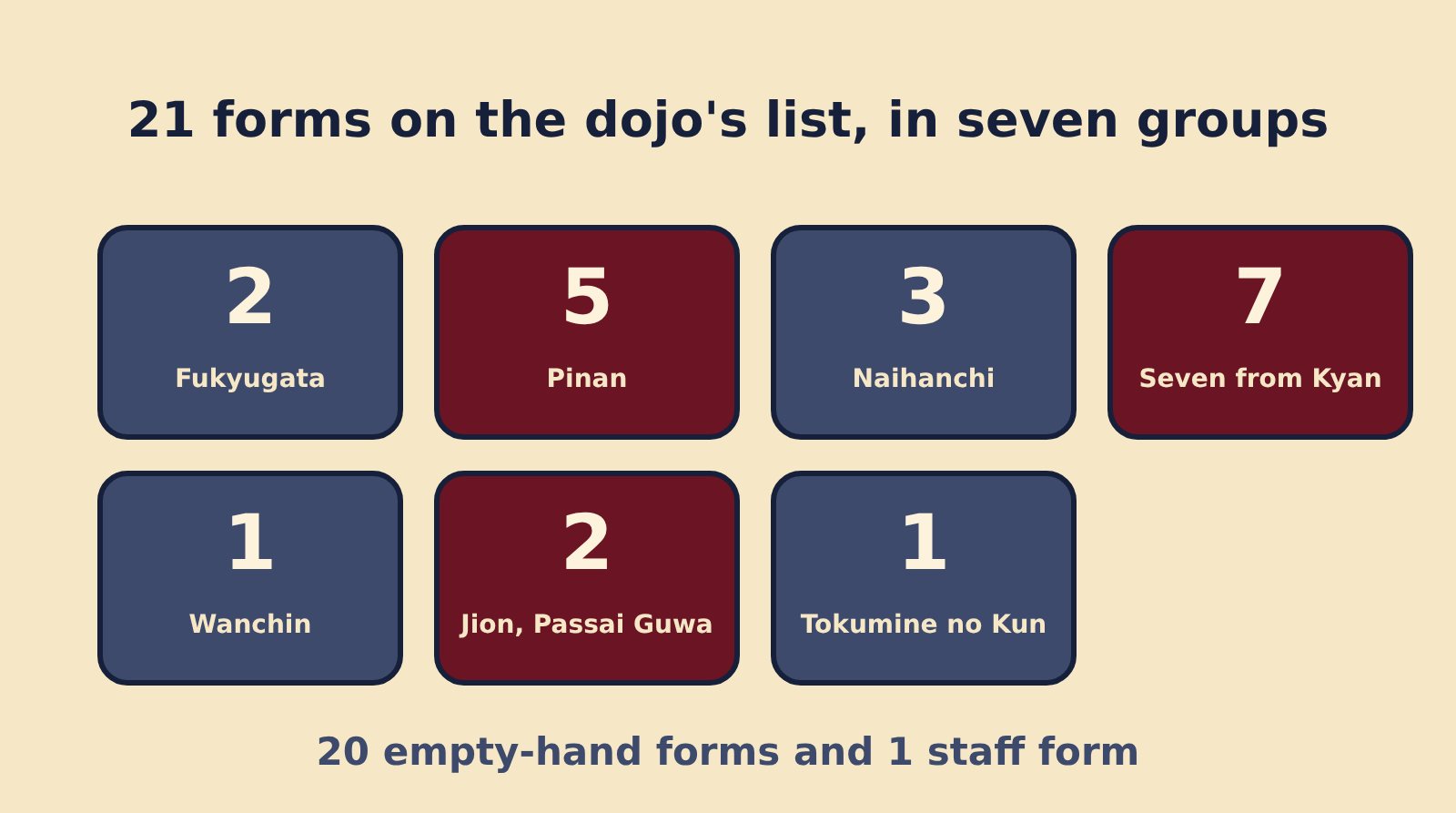
The dojo’s site lists these kata: Fukyugata Ichi and Ni; Pinan 1 to 5; Naihanchi 1 to 3; Seisan; Ananku; Wansu; Passai; Gojushiho; Chinto; Kusanku; Wanchin; Jion; Passai Guwa; and Tokumine no Kun. By our count that is 21 forms. Twenty are empty-hand, and one, Tokumine no Kun, is a staff form (we follow it in our post on the staff). A kata, as Wikipedia puts it, is “a detailed choreographed pattern of martial arts movements”.
The site does not say that every one of the 21 is taught at Ōrākei, in what order, or at which grade. We will not match them up. The list is the syllabus the dojo publishes, and that is all it tells us.
The seven from Kyan
The clearest sourcing is for a group of seven. In an interview in Dragon Times, “The Karate of Chotoku Kyan: Interview with the Seibukan’s Zenpo Shimabukuro“, Zenpo lists what he learned from his father: “I learned the kata Seisan, Ananku, Wansu, Passai, Gojushiho, Chinto, Kusanku and the kata Wanchin that my father created.” Asked what his school teaches, he says: “We teach the seven kata from Kyan sensei.” Take the eight names he gave, remove Wanchin, and seven remain: Seisan, Ananku, Wansu, Passai, Gojushiho, Chinto and Kusanku.
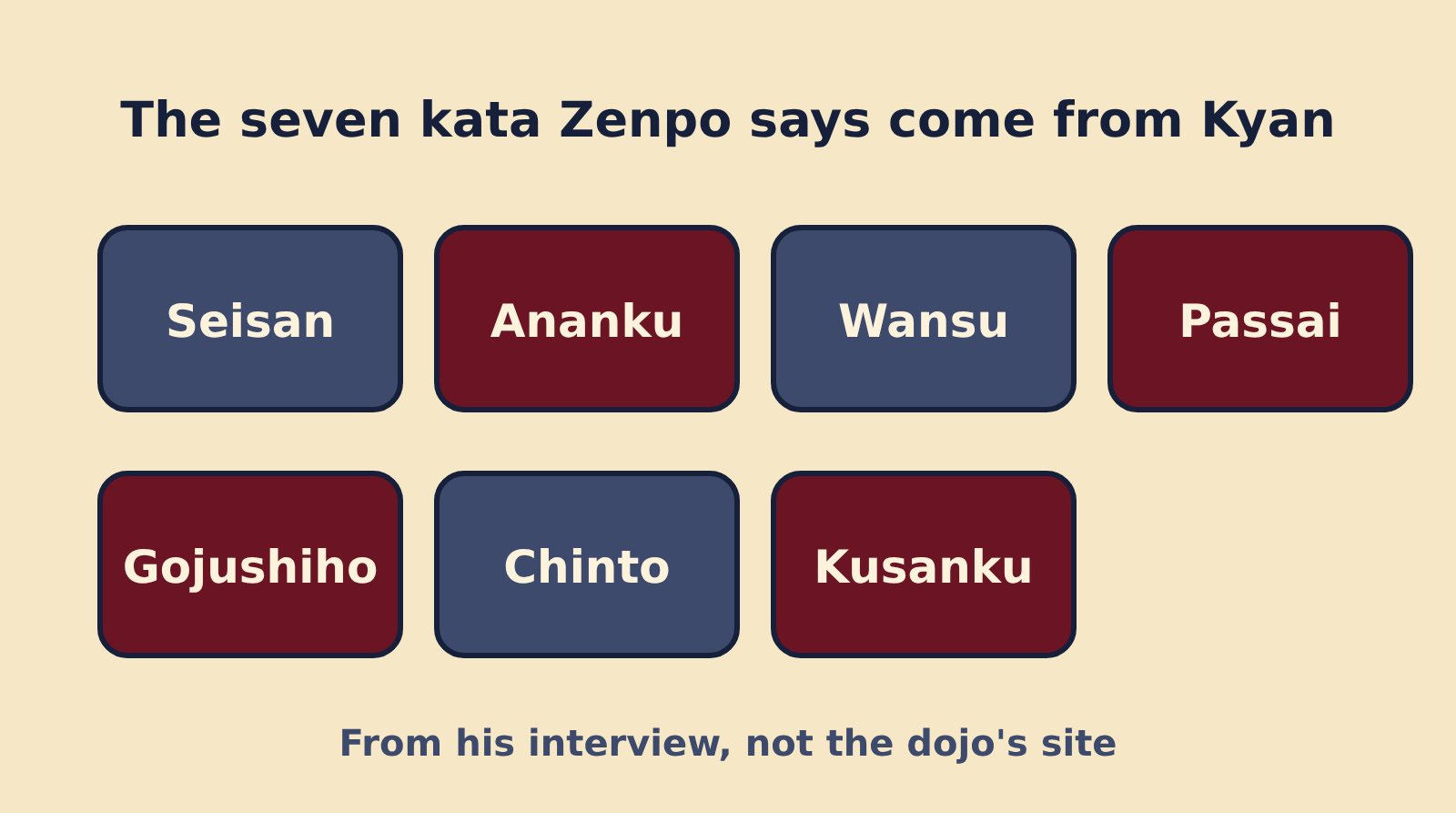
All seven are on the Ōrākei list. The dojo’s own site credits one of them, Ananku, to Kyan Chōtoku by name, saying he created it, as we noted in who Kyan was.
The one his father made
Wanchin stands apart. The same line in the interview describes it as the kata “that my father created”. His father is Shimabukuro Zenryo, who founded Seibukan in 1962, whose story we tell in the post on the founding. So among the 21, the interview marks one form as the founder’s own.
The beginners’ forms
Fukyugata Ichi and Ni are at the head of the dojo’s list. The interview mentions them in passing: “I have also started teaching the Fukyu kata several years ago.” That suggests they were added to what he teaches in his later years, not that they were among the forms he learned as a boy. The site does not say they are the first forms a new student learns, though their place at the start of the list is suggestive. Ask the instructors.
The groups with no source
Here the trail stops. Pinan 1 to 5, Naihanchi 1 to 3, Jion and Passai Guwa are all on the dojo’s list. Neither the site nor the interview passages we used says where they came from or how they fit into the line. There is more written about these forms elsewhere, but we have not used it, because we can only source claims from the dojo’s own line. We would rather leave a gap than fill it with something we cannot source.
What the map suggests
Even with the gaps, a shape appears. Roughly a third of the list is a core of seven forms the Supreme Sensei traces to Kyan, with one form his father made, one staff form given to his father by Kyan, and a set of other forms the sources are silent about. The interview describes the order of teaching simply: “kihon renshu for new students before beginning the kata”, and then the forms. So the kata are not the starting point. They are what the basics are for.
That connects to the idea we looked at in tanren, the repeated practice that shapes the body, and to bunkai, the meaning behind each form, explained in what bunkai is.
How to use a list this long
Twenty-one forms can look like a mountain, and it is worth saying plainly that no one learns them at once. The dojo’s site describes grading as held about every six months, and says nothing about how many forms a student should expect in that time. A sensible way to hold the list is as a long road with a few markers: the first forms you learn, the forms from Kyan, the one Zenryo made, and the staff form at the end. Ask your instructors which marker you are working towards now.
Questions to ask the instructors
These are our suggestions, not the dojo’s wording:
- Which kata does a new student learn first, and in what order do the rest follow?
- Are all 21 on the list taught at Ōrākei, or only some so far?
- Which kata belong to which grade?
- How does a student tell the forms from Kyan apart from the later ones?
If you are new
You do not need to know any kata to start. The first two classes are free, with no obligation, on Wednesdays and Fridays, 6 to 7pm, at Ōrākei Community Centre, 156 Kepa Road. Wear comfortable clothes you can move in, arrive 10 minutes early, and tell the instructors about any injury or health condition. The current term runs from 7 October to 18 December. Call 029 128 0873 or fill in the form.
Frequently asked questions
How many kata does the Ōrākei dojo list?
The dojo’s site lists 21 forms by our count: Fukyugata Ichi and Ni, Pinan 1 to 5, Naihanchi 1 to 3, Seisan, Ananku, Wansu, Passai, Gojushiho, Chinto, Kusanku, Wanchin, Jion, Passai Guwa and Tokumine no Kun. Twenty are empty-hand and one is a staff form.
Which kata come from Kyan?
In an interview, Zenpo Shimabukuro says his school teaches “the seven kata from Kyan sensei”: Seisan, Ananku, Wansu, Passai, Gojushiho, Chinto and Kusanku. The dojo’s site credits Kyan with creating Ananku.
Who made Wanchin?
According to the same interview, Zenpo’s father, Shimabukuro Zenryo, created it.
Are all of them taught at Ōrākei?
The site does not say. Ask the instructors which are taught and in what order.
When are the classes?
Wednesdays and Fridays, 6 to 7pm, at Ōrākei Community Centre, 156 Kepa Road. The first two classes are free.
Sources
- IOSSKA-NZ, seibukan.co.nz: the kata list, Kyan and Ananku, class times and venue (checked November 2026).
- The Karate of Chotoku Kyan: Interview with the Seibukan’s Zenpo Shimabukuro, Dragon Times: the kata Zenpo learned, the seven from Kyan, Wanchin, the Fukyu kata and kihon renshu before kata. Read for these passages only.
- Kata, Wikipedia: term meaning only.
Curious? Your first two classes are free: Wednesdays and Fridays, 6 to 7pm, at Ōrākei Community Centre. Call now or fill in the form.