Every dojo has a name on the wall, or a photograph, or a story told at the start of the term. For members of the Seibukan family, the first name in that story is Chōtoku Kyan. If you have trained for a while, you have probably heard it. If you have just started, you may wonder why a man born in 1870 matters to a class in Ōrākei.
This post sets out what the dojo says about Kyan, adds some plain context from public sources, and is honest about what we do not know. Facts about the lineage come from the dojo’s own site at seibukan.co.nz, checked in October 2026.
What the dojo says about Kyan
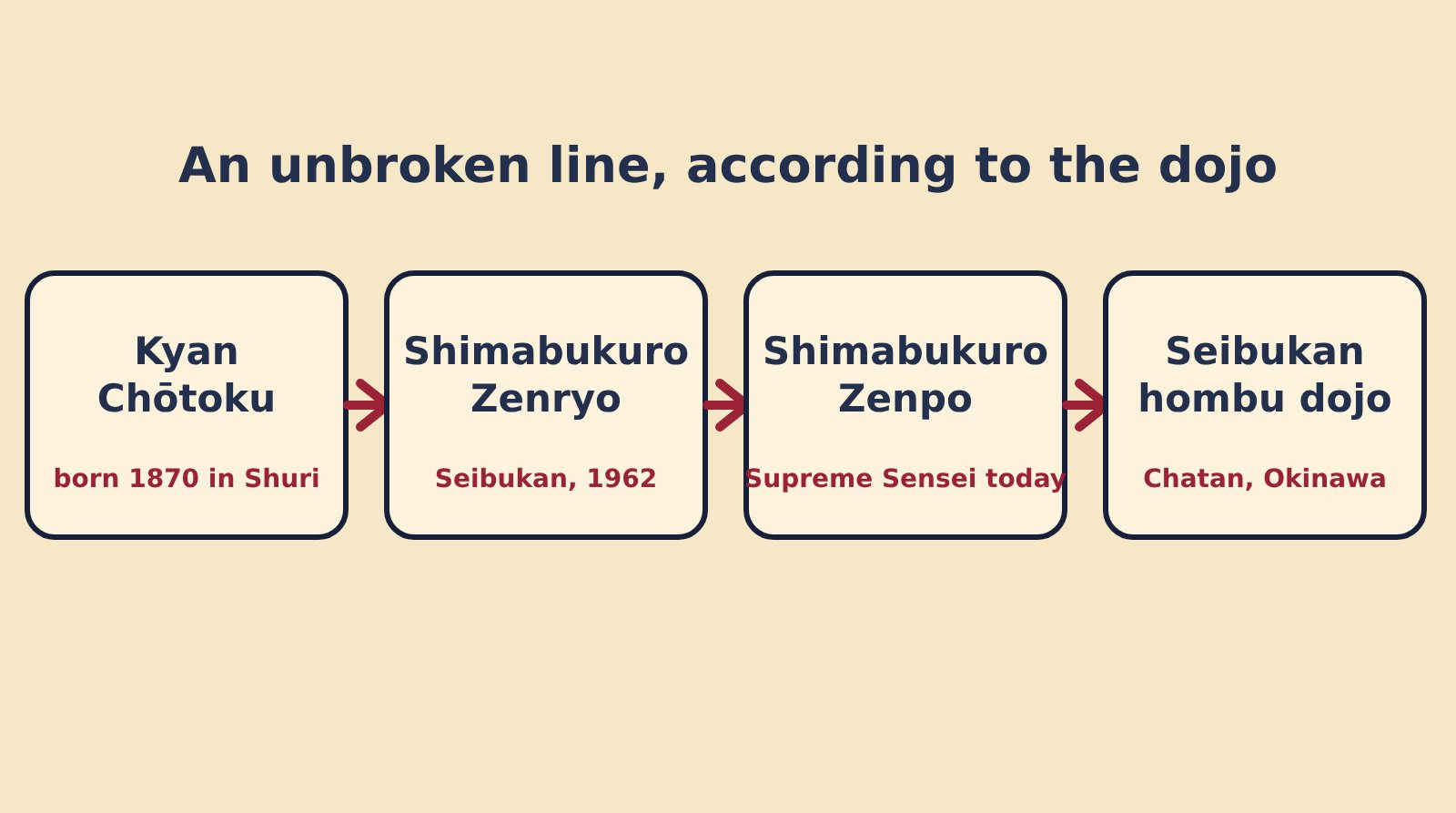
The lineage section of the dojo’s site opens in 1870. It says Kyan Chotoku was born in Shuri, learned from six masters, and created the kata Ananku. It then describes “an unbroken line from Kyan Chotoku to the Seibukan hombu dojo in Chatan, Okinawa”. A hombu dojo is a headquarters dojo.
The next step in that line is Kyan’s direct student, Shimabukuro Zenryo, who named the dojo Seibukan in 1962. Today the association is led by Shimabukuro Zenpo, 10th Dan Hanshi and Supreme Sensei. The posts on this blog will cover those later chapters. This one stays with where it starts.
Shuri: where the story begins
Kyan’s birthplace was no backwater. According to Wikipedia’s Shuri entry, Shuri “was once the royal capital of the Ryūkyū Kingdom”. King Shō Hashi made it the capital in the early 1400s, and it stayed the royal capital for roughly 450 years, until the kingdom was annexed.
Shuri Castle stood at the centre of it. The same entry says the castle was first built in the mid-1200s and was destroyed in the Battle of Okinawa in 1945. The castle, its Shureimon gate and other sites in Shuri are now UNESCO World Heritage Sites, and the palace’s main hall was rebuilt in 1992. A boy born in Shuri in 1870 grew up in the shadow of that history.
The man, as far as public sources go
Wikipedia’s entry on Chōtoku Kyan gives his dates as December 1870 to 20 September 1945. It describes him as a karate master “famous for both his karate skills and his colorful personal life”, and says he was small in stature and suffered from asthma. It says he survived the Battle of Okinawa in 1945 but died that September “from fatigue and malnutrition”.
We have kept to those basics. Wikipedia is a general reference with its own limits, so treat the details as background rather than as the dojo’s account.
Ananku: a kata with a name attached
The dojo’s site credits Kyan with creating the kata Ananku. A kata, according to Wikipedia, is “a detailed choreographed pattern of martial arts movements” practised as a way to memorise and perfect them. The dojo lists Ananku among the kata of its syllabus, alongside Fukyugata Ichi and Ni, Pinan 1 to 5, Naihanchi 1 to 3, Seisan, Wansu, Passai, Gojushiho, Chinto, Kusanku, Wanchin, Jion, Passai Guwa and Tokumine no Kun.
That is worth sitting with. When a student practises Ananku in Ōrākei, the pattern they are tracing is, by the dojo’s account, one that Kyan created. The site does not give a date for the kata, so we will not guess one.
How the line reaches Ōrākei
A lineage only matters to a beginner if it connects to the people standing in front of you. The dojo’s site sets that connection out, and it is worth following step by step.
- Kyan Chotoku taught Shimabukuro Zenryo, who named Seibukan in 1962.
- Zenryo’s son, Shimabukuro Zenpo, is now the Supreme Sensei. The site lists him as 10th Dan Hanshi.
- Kyoshi P R Ratnapala, a 7th Dan, is the dojo’s advisor and Chief Instructor of Seibukan in India. The site says he has trained since 1972 and has studied under Zenpo since 1993.
- Sensei Sri Ramamurthy, an instructor at the Ōrākei dojo (Ni Dan), has trained since 1985 under Sensei Ratnapala. He moved to New Zealand in 2001, when, the site says, Seibukan “first took root in Auckland”: he opened three dojos and taught about 250 students.
- Sensei Prinkal Nizama, Chief Instructor and Technical Director (Godan), has 31 years of karate, according to the site.
Read plainly, that is a chain of named teachers from Shuri in 1870 to a community hall in Ōrākei today, as the dojo tells it. We cannot verify each link from outside, and we do not claim to. What we can say is that the dojo is open about who taught whom, which is the kind of openness worth looking for in any dojo. Ask the instructors to tell the story in their own words.
What an unbroken line can and cannot tell you
A lineage tells you where the teaching came from. It does not tell you how well it is taught on a Wednesday night. That comes from the class itself: how clearly the instructors explain things, how they treat beginners, and how safe the room feels. The first two classes are free so you can judge that for yourself. Think of the lineage as the “why”, and the class as the proof.
Why a lineage matters to a beginner
You do not need to know any of this to start. The dojo’s first two classes are free, you wear comfortable clothes, and the instructors will show you what to do. But a lineage explains something about how the dojo teaches. It says the training is “still taught the traditional way: kata, kihon and kumite, with respect at the centre of everything”, and that its Supreme Sensei teaches that “karate is not a sport. Real self-defence, focus and self-belief.”
An unbroken line, in other words, is a claim about continuity: that what you learn is meant to be what was handed down, not rebuilt from scratch. That is the dojo’s claim, and the dojo’s to prove through its teaching. What we can say is that it is a claim worth knowing about before you decide whether this is the place for you.
Where to go next
If you would like to see the teaching rather than read about it, call 029 128 0873 or fill in the form to book your two free classes. For what the evening involves, see what to expect at your first class.
Frequently asked questions
Who was Chōtoku Kyan?
According to the dojo’s site, Kyan Chotoku was born in Shuri in 1870, learned from six masters and created the kata Ananku. Wikipedia gives his dates as December 1870 to 20 September 1945.
Why does Seibukan trace its line to Kyan?
The dojo says there is an unbroken line from Kyan Chotoku to the Seibukan hombu dojo in Chatan, Okinawa. Kyan’s direct student, Shimabukuro Zenryo, founded Seibukan in 1962.
What is Shuri?
Shuri is a district of Naha, Okinawa, and was once the royal capital of the Ryūkyū Kingdom, according to Wikipedia. Shuri Castle was destroyed in the Battle of Okinawa in 1945, and its main hall was rebuilt in 1992.
What is Ananku?
Ananku is a kata. The dojo’s site says Kyan Chotoku created it, and it is one of the kata in the dojo’s syllabus. A kata is a pattern of movements practised to memorise and perfect them.
Who teaches at the Ōrākei dojo?
The dojo’s site lists Sensei Prinkal Nizama (Chief Instructor and Technical Director, Godan) and Sensei Sri Ramamurthy (Instructor, Ni Dan), with Kyoshi P R Ratnapala (7th Dan) as advisor.
Do I need to know the history to join?
No. The first two classes are free, you wear comfortable clothes you can move in, and the instructors show you what to do. The history is there if you want it.
Sources
- IOSSKA-NZ, seibukan.co.nz: lineage, philosophy and kata list (checked October 2026).
- Chōtoku Kyan, Wikipedia: dates, health, and the 1945 Battle of Okinawa. A general reference, used for background only.
- Shuri, Okinawa, Wikipedia: Shuri as the royal capital of the Ryūkyū Kingdom, and Shuri Castle.
- Kata, Wikipedia: what a kata is.
Curious about training? Your first two classes are free: Wednesdays and Fridays, 6 to 7pm, at Ōrākei Community Centre. Call now or fill in the form.