If you have trained for a few months, you will know the feeling. It is the fortieth time this evening that you have thrown the same basic technique, nothing about it is new, and the instructor says “again”. Your mind drifts to what is for dinner. Then, somewhere in the middle of the repetition, something small improves: your hip arrives a fraction earlier, a shoulder drops, the technique stops feeling like something you do and starts feeling like something you are.
Okinawan karate has a word for that process: tanren. This post looks at what the word means, what a published account of Seibukan training says about it, and what we can and cannot say about how it is practised at the IOSSKA-NZ dojo in Ōrākei. We have kept to sources we could read and have marked where the trail runs out.
What tanren means
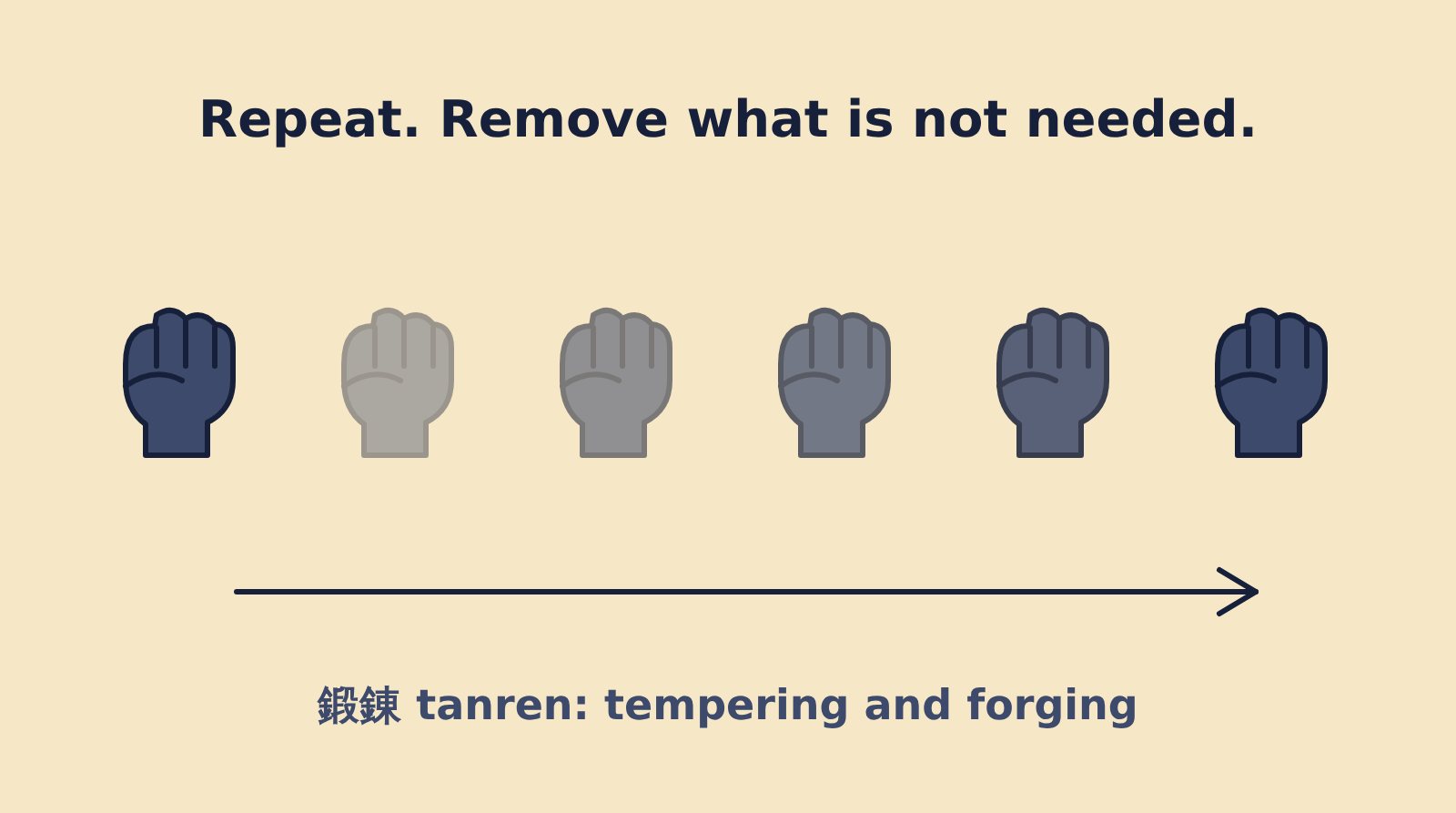
Tanren is written 鍛錬. An article on Budo Japan describing a visit to the dojo of Supreme Sensei Zenpo Shimabukuro, who leads the IOSSKA, puts it this way: “tanren (鍛錬) literally means tempering and forging”. The picture is a blacksmith’s: metal heated, hammered and folded until it holds an edge.
The same article describes the method as repetition: “all about repeating the same movement over and over again, sanding it down until every unnecessary gesture is erased.” Notice what that does and does not say. It is not about adding more techniques. It is about taking away what is not needed from the ones you already have.
The same exercises, every session
The Budo Japan piece makes a striking claim about Seibukan’s own dojo in Okinawa: “At Seibukan, the same series of physical exercises has been performed at every session for over 60 years.” It names two groups of exercises, Kihon Renshū (basic exercises) and Zenshin Kōtai (advancing and retreating), and says they include warm-up techniques and the striking and defensive movements found in kata.
That date lines up with the lineage on the IOSSKA-NZ site, which records that Shimabukuro Zenryo founded Seibukan in 1962, a story we cover in the founding of Seibukan. It is a claim about the hombu (headquarters) dojo in Chatan, and we have not been able to verify it independently. We repeat it as the article’s account, not as ours.
The article also records a line it attributes to the Dōjōkun, the dojo’s training principles: “In mastering Karate, training (or forging the body & mind) is more important than theory.” The IOSSKA-NZ site does not publish a formal dojo kun, so we cannot say how this wording is used in Ōrākei. It does fit the site’s own statement that respect and discipline are at the centre of its karate.
Why repetition is not boring (when it is done well)
It is easy to hear “the same exercises every session for sixty years” as a description of tedium. The point of the idea is the opposite. Because the exercise stays the same, everything that changes is you.
Wikipedia’s entry on kihon, the Japanese word for “basics” or “fundamentals”, says kihon techniques “tend to be practiced often, in many cases during each practice session”, and that kihon is “essential to all advanced training”. A black belt and a first-week beginner can stand in the same line, doing the same basic movement, and the difference between them is what tanren is meant to produce.
Tanren and kata
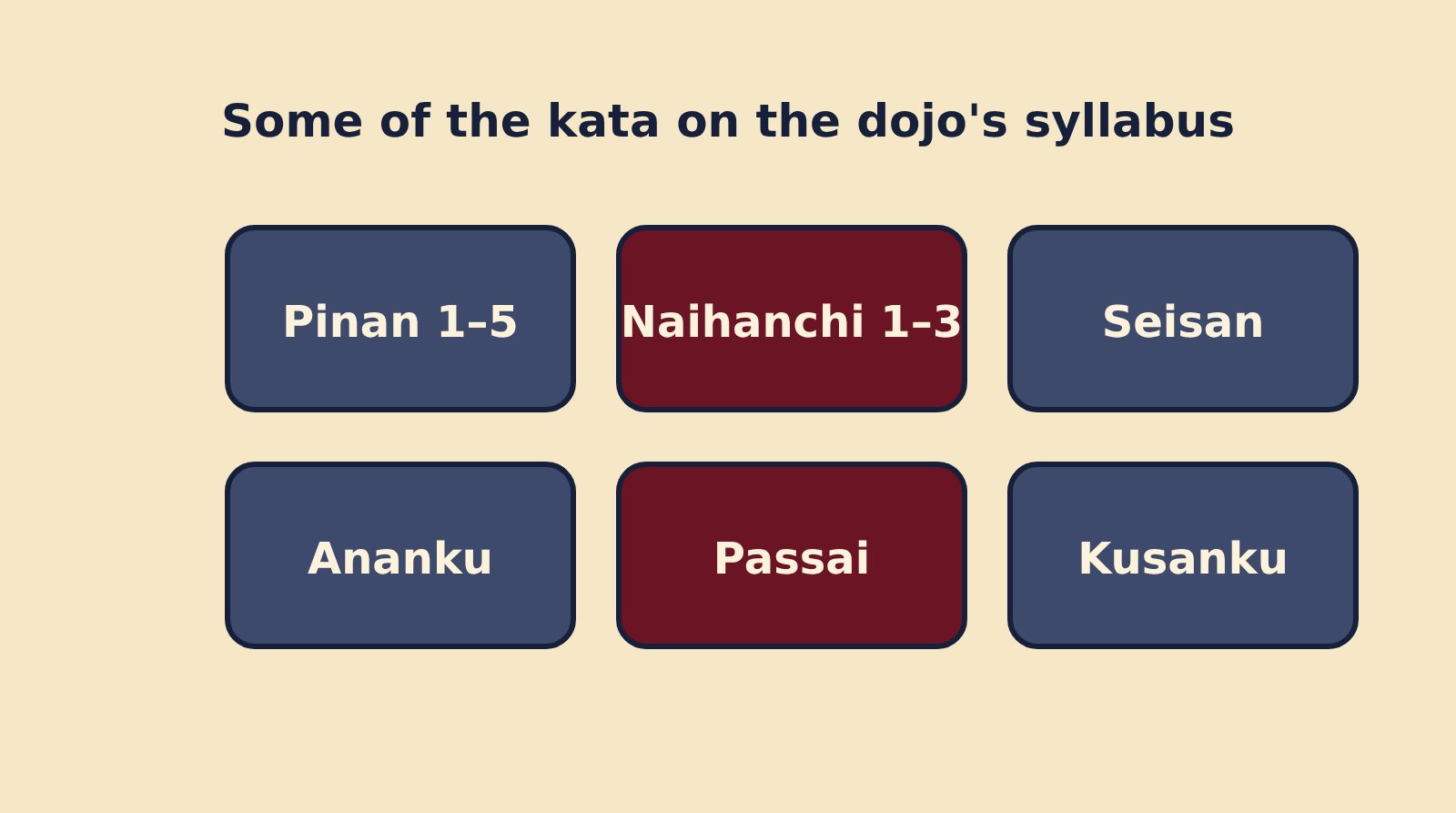
The dojo’s site lists a kata syllabus that includes Fukyugata Ichi and Ni, Pinan 1 to 5, Naihanchi 1 to 3, Seisan, Ananku, Wansu, Passai, Chinto, Kusanku, Wanchin, Jion, Passai Guwa and Tokumine no Kun. Kata are set sequences of movement, practised alone and repeated across years.
Read through the lens of tanren, a kata is not a thing you finish. You learn the order of the movements in a few weeks, and then you spend years sanding them down. That is also why meaning matters: we explain in what bunkai is and why kata is more than memorised movement how the applications behind each sequence give the repetition a purpose.
What we do not know
The IOSSKA-NZ site does not set out what happens minute by minute in a class, so we cannot tell you which exercises open an Ōrākei session, how long the warm-up is, or whether the Okinawan routine described in the article is used as it is. If you are a member, you know. If you are curious, those are good questions for the instructors:
- What does the first part of a class look like, and how much of it is repeated each week?
- How do you tell a beginner which of the movements to work on this month?
- How does repetition of basics connect to the kata the class is learning?
One more thread: the site Listening to Okinawa Karate lists an article titled “Chiimigukuru: Embodied Wisdom in Okinawan Karate Training”. We could see only its title, so we do not rely on it here. It is on our list for a future post.
If you are new
You do not need to understand any of this to start. Tanren is something you discover by doing, usually without noticing. The dojo’s first two classes are free, with no obligation, on Wednesdays and Fridays, 6 to 7pm, at Ōrākei Community Centre, 156 Kepa Road. Wear comfortable clothes you can move in, and arrive 10 minutes early for a welcome and a walk through the basics. The current term runs from 7 October to 18 December. Tell the instructors about any injury or health condition before class.
Frequently asked questions
What does tanren mean?
It is written 鍛錬 and, in the words of an article on Seibukan training, “literally means tempering and forging”. It describes training by repetition until unnecessary movement is removed.
Is tanren the same as conditioning?
The article uses it for forging both body and mind through repetition, and the principle it quotes says that forging “the body & mind” matters more than theory. We have not found the dojo using the word in a narrower, physical-only sense.
Does the Ōrākei dojo do the same exercises every session?
The article says this of Seibukan’s headquarters dojo in Okinawa. The IOSSKA-NZ site does not list class contents, so ask the instructors what a typical session includes.
Is tanren the same as kihon?
No. Kihon means the basic techniques. Tanren is the way of training that works on them, and on kata, through repetition. The article names Kihon Renshū, the basic exercises, as one of the groups of exercises it describes.
Can a beginner train this way?
The dojo’s first two classes are free and open to all ages, and you are asked to tell the instructors about any injury or health condition beforehand so they can train you safely.
Sources
- IOSSKA-NZ, seibukan.co.nz: class times, venue, lineage, kata syllabus, respect and discipline, safety wording (checked October 2026).
- Immersion in the ways of Okinawan power: visit to Zenpo Shimabukuro’s Dōjō, Budo Japan: the meaning of tanren, repetition, the exercises performed every session and the Dōjōkun line. Read for the tanren passages only.
- Kihon and Kata, Wikipedia: term meanings only.
- Listening to Okinawa Karate: article title only, not relied on.
Curious? Your first two classes are free: Wednesdays and Fridays, 6 to 7pm, at Ōrākei Community Centre. Call now or fill in the form.