When you have trained long enough you start to wonder where the habits of your dojo come from. Why the basics come first and last. Why the same movement is asked of you again and again. Why the instructor sometimes tells you to stop thinking about it. The simplest way to find out is to ask the person at the head of the line.
Zenpo Shimabukuro, 10th Dan Hanshi, is the Supreme Sensei of Seibukan and leads the IOSSKA, the association the Ōrākei dojo belongs to. Dragon Times interviewed him for “The Karate of Chotoku Kyan: Interview with the Seibukan’s Zenpo Shimabukuro“, and some of his answers describe how Seibukan is taught. This post lets those answers speak, with the dojo’s own site beside them. We have read the interview for the passages about Seibukan only. It is one person’s account, in a magazine, and it describes Okinawa, not Ōrākei. Dojo facts are from the dojo’s own site, checked in October 2026.
A boy of nine
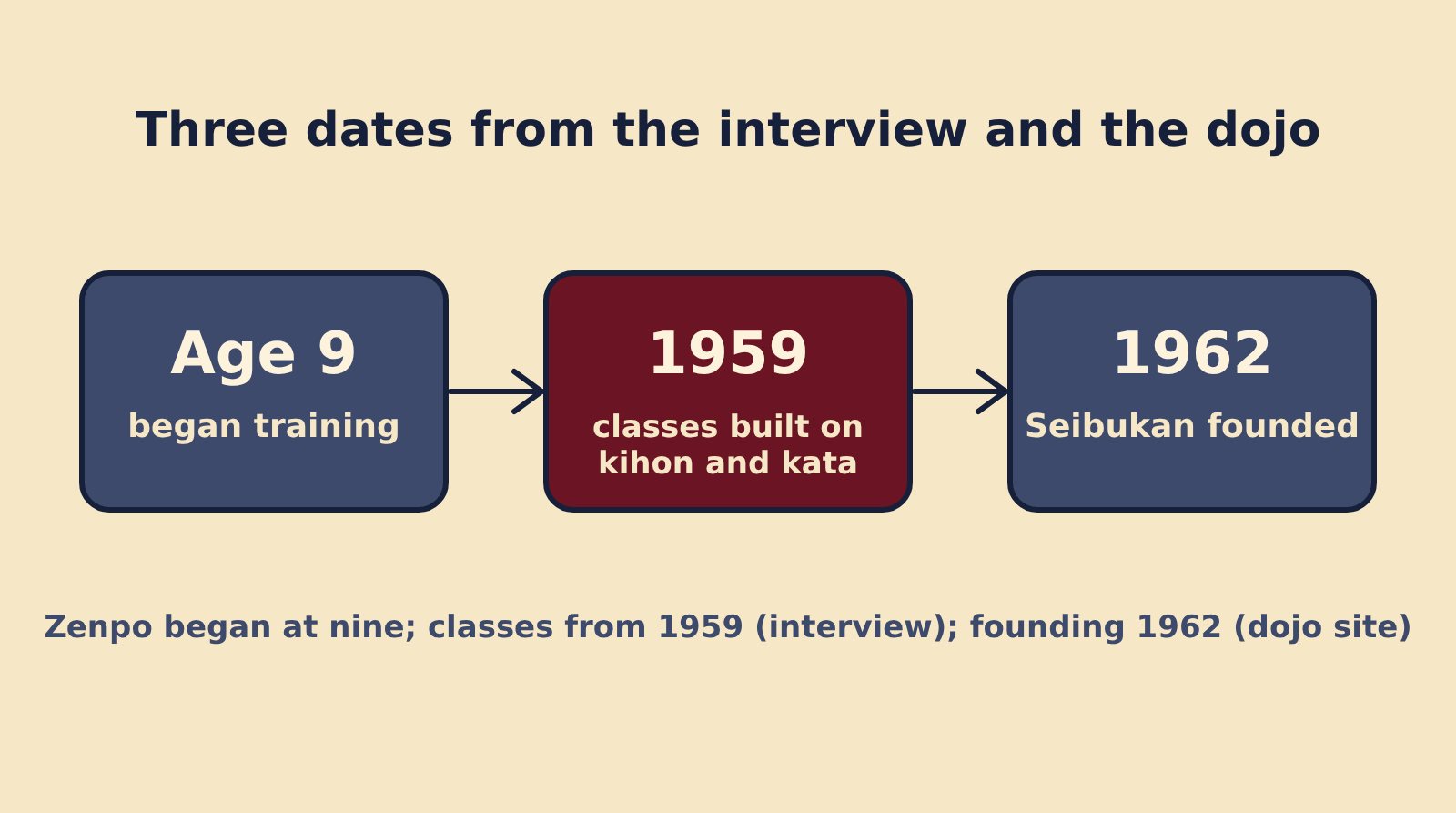
Asked at what age he started, Zenpo says: “I began training at the age of nine.” Most people started later, but “since my father was the teacher I began early”. His father is Shimabukuro Zenryo, who founded Seibukan in 1962, as we cover in the post on the founding.
Asked what form his training took, he says: “My father began teaching me and my cousin, Zenji, kata but then decided to make a set of kihon exercises to help develop us.” And: “He created the use of kihon renshu for new students before beginning the kata.” So the order, in his telling, is the body first and the forms second. Kihon renshu are basic exercises, and our post on tanren looks at how repetition of basics is described in another account of the same dojo.
Kihon, kata, kumite and the body
He describes his own training in one line: “We trained in kihon, kata, kumite, and physical training with weights and makiwara.” Those first three words are the same three the Ōrākei dojo uses to describe its classes, “Traditional kata, kihon and kumite”. The makiwara is a striking post used for conditioning the hands. He adds that “in the old days we did makiwara training and weight training everyday”, that “today we do not emphasis this type of training too much”, and that “I continue to train the old way as do most of my senior students but the newer students do not train this way.”
We cannot tell you what an Ōrākei class includes, and the dojo’s site does not say whether makiwara or weights are part of it. What the interview gives is the Supreme Sensei’s own account of his own school, including the fact that senior and newer students are not asked to train the same way.
The mind will forget
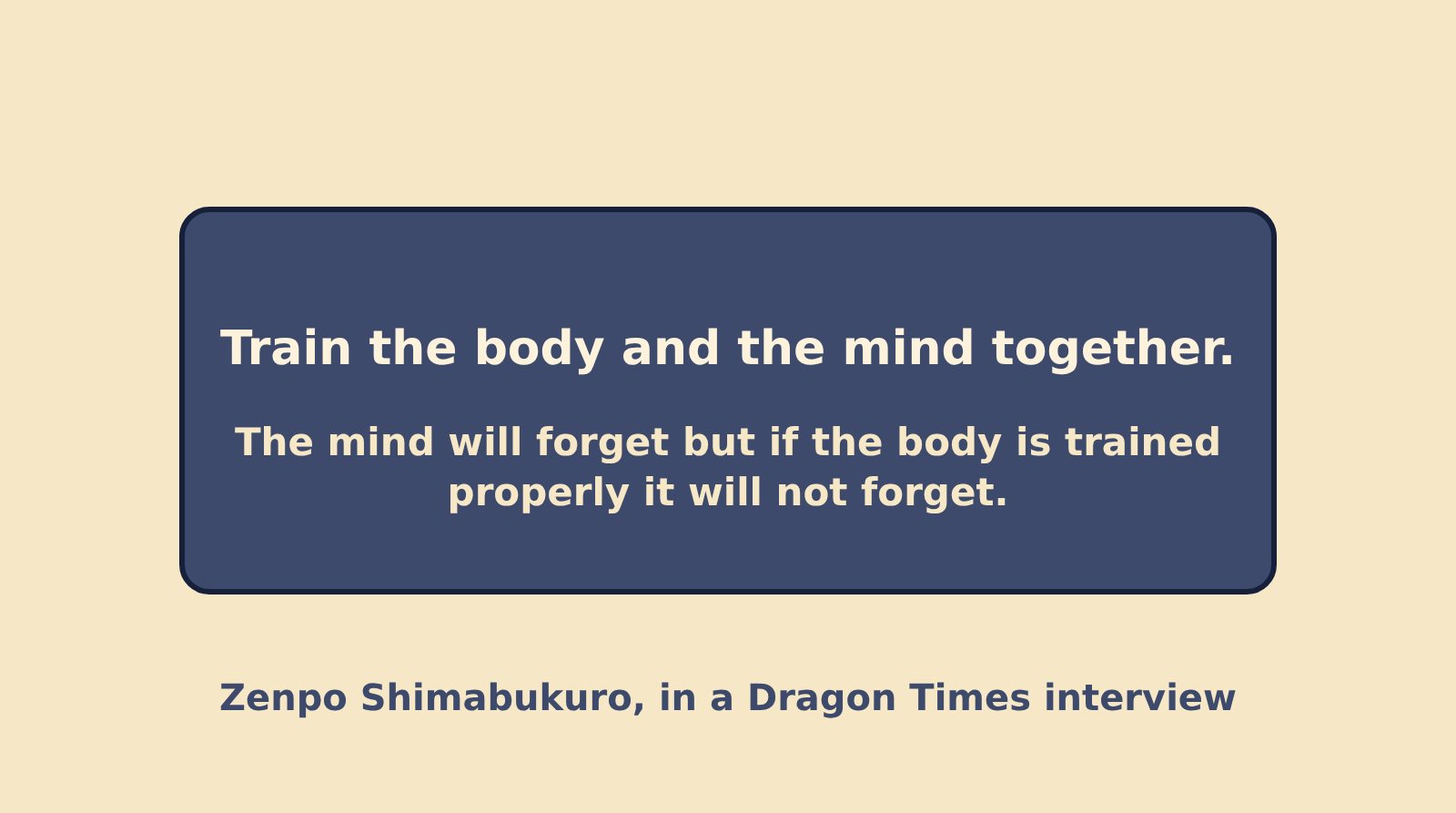
The passage members tend to remember is about the relationship between thinking and training. Asked how important it is to understand what you are doing, he answers: “To understand what you are doing with your body is very important but more important is the body training.” Then: “Train the body and the mind together.” And: “The mind will forget but if the body is trained properly it will not forget.”
He says bunkai, the meaning behind each kata movement, is taught “from the beginning of training”, and that “the bunkai or demonstration of what you are doing is continuously being demonstrated in my school”. Then he adds that one can “think to much about bunkai” (the spelling is the interview’s). It is not a dismissal. It is the same point again: understanding matters, and it has to live in the body. Our post on bunkai and kata explains the term.
The kata he learned
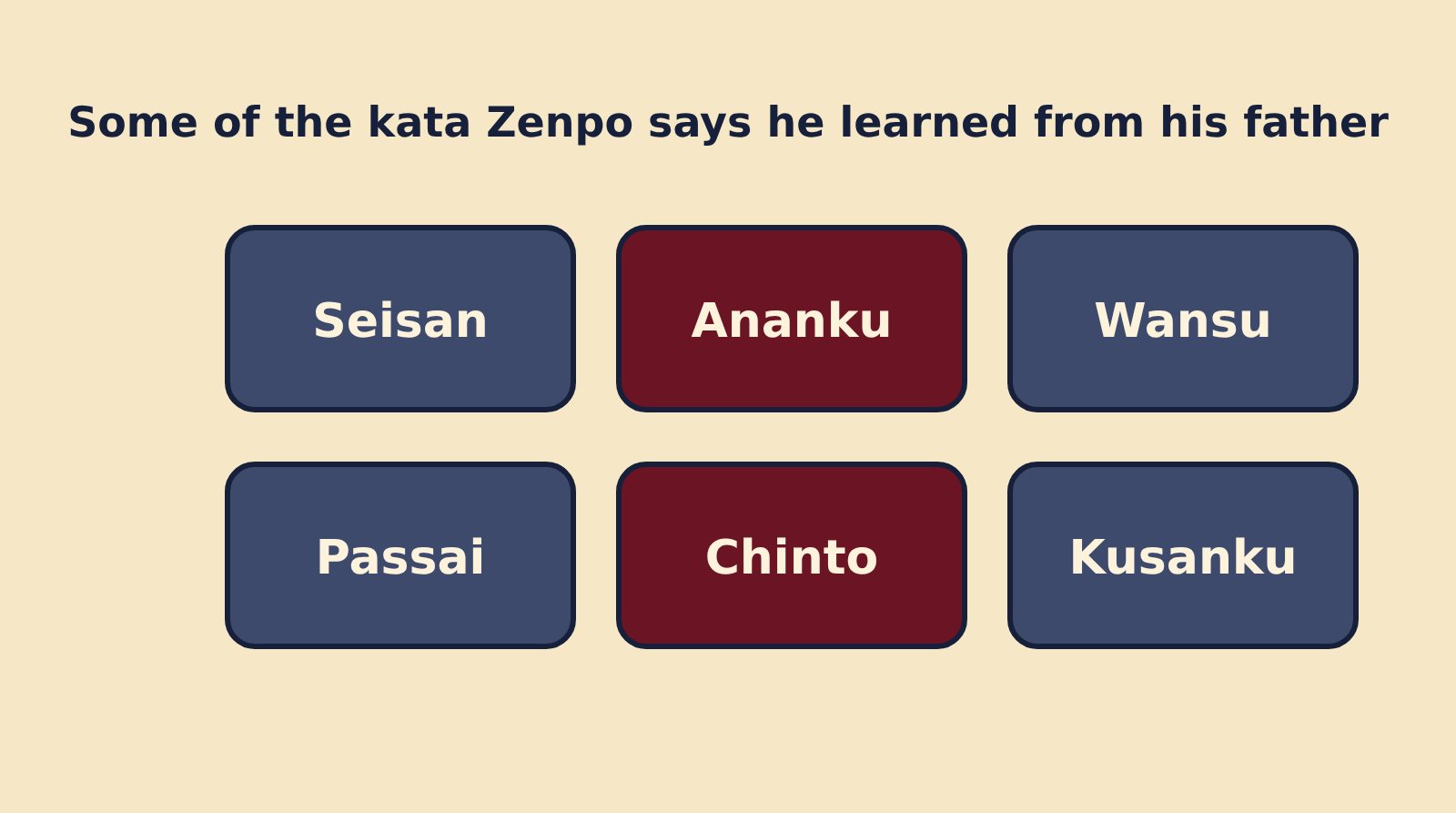
He lists what he learned from his father: “I learned the kata Seisan, Ananku, Wansu, Passai … Chinto, Kusanku and the kata Wanchin that my father created.” And of his school today: “We teach the seven kata from Kyan sensei.” He also says he started teaching the Fukyu kata several years ago, which matches the Fukyugata Ichi and Ni on the Ōrākei dojo’s own syllabus.
He is clear about where the line runs. His father, he says, “studied with Kyan longer than any other student”, received instruction “at his home”, and began training with Kyan in “approximately 1930”. His father learned “the kata only which is much different from modern training in group classes”, and “began using the modern approach in 1959 with classes being centered around kihon and kata”. We tell the wider story in who Kyan Chōtoku was.
What he hopes for
Asked about his school’s future, Zenpo says: “I would like to the cultural treasure of Okinawa spread throughout the world.” The Ōrākei dojo is one small part of that. The dojo’s site says Seibukan first took root in Auckland in 2001, and that the association has dojos in Japan, Europe, Russia, the USA, India, the Middle East and elsewhere. We follow the line to Auckland in Seibukan today.
What we cannot tell you
The interview is about Okinawa and about Zenpo’s own school. It does not tell you how the Ōrākei instructors run a class. If you are curious, these are worth asking:
- How much of a class is basics, and how much is kata?
- When do new students begin learning bunkai?
- Which conditioning, if any, is part of training here?
If you are new
You do not need to know any of this to start. The first two classes are free, with no obligation, on Wednesdays and Fridays, 6 to 7pm, at Ōrākei Community Centre, 156 Kepa Road. Wear comfortable clothes you can move in, arrive 10 minutes early, and tell the instructors about any injury or health condition. The current term runs from 7 October to 18 December, and bookings for next year will be announced shortly. Call 029 128 0873 or fill in the form.
Frequently asked questions
Who is Zenpo Shimabukuro?
The dojo’s site lists him as 10th Dan Hanshi and Supreme Sensei, leading the IOSSKA with his son Zenshun. He is the son of Seibukan’s founder, Shimabukuro Zenryo.
What does he say about training the body?
In a Dragon Times interview he says “train the body and the mind together”, and that “the mind will forget but if the body is trained properly it will not forget”.
Does Seibukan teach bunkai?
He says it is taught from the beginning of training, and that he believes one can think “to much” about it. Understanding is important, he says, but body training matters more.
Do students at the Ōrākei dojo train with makiwara or weights?
The dojo’s site does not say. The interview describes Zenpo’s own training in Okinawa, and notes that his newer students do not train that way.
When are the classes?
Wednesdays and Fridays, 6 to 7pm, at Ōrākei Community Centre, 156 Kepa Road. The first two classes are free.
Sources
- IOSSKA-NZ, seibukan.co.nz: Supreme Sensei, lineage, kata syllabus, association, class times and venue (checked October 2026).
- The Karate of Chotoku Kyan: Interview with the Seibukan’s Zenpo Shimabukuro, Dragon Times: his early training, kihon renshu, the kata he learned, body training and bunkai. Read for these passages only.
Curious? Your first two classes are free: Wednesdays and Fridays, 6 to 7pm, at Ōrākei Community Centre. Call now or fill in the form.