When we first wrote about the Black Belt & Advanced program at the IOSSKA-NZ dojo, we had one line to work with: “Deep study of Seibukan kata, bunkai and weapons for senior students.” We said then that we would rather admit the gaps than guess. In the weeks since, this blog has looked closely at each of those three strands, and we now know a good deal more about what the words point to.
This post brings it together. It is for senior students and for anyone curious about where training leads. We use the dojo’s own site and the passages about Seibukan in a published interview with its Supreme Sensei. Where there is still nothing written down, we say so. Dojo facts are from its own site, checked in November 2026.
What the program line still tells us
It is worth being plain about what has not changed. The site gives one line for the program and no price, timetable or entry requirement. It does not say what makes a student “senior”, whether that means a grade, years of training or an invitation, or whether the program runs inside the Wednesday and Friday, 6 to 7pm classes or separately. Our original post, Black Belt and Advanced training at the Ōrākei dojo, sets out those gaps. They are still gaps, and they are the first things to ask the instructors.
Kata: a long list with a core
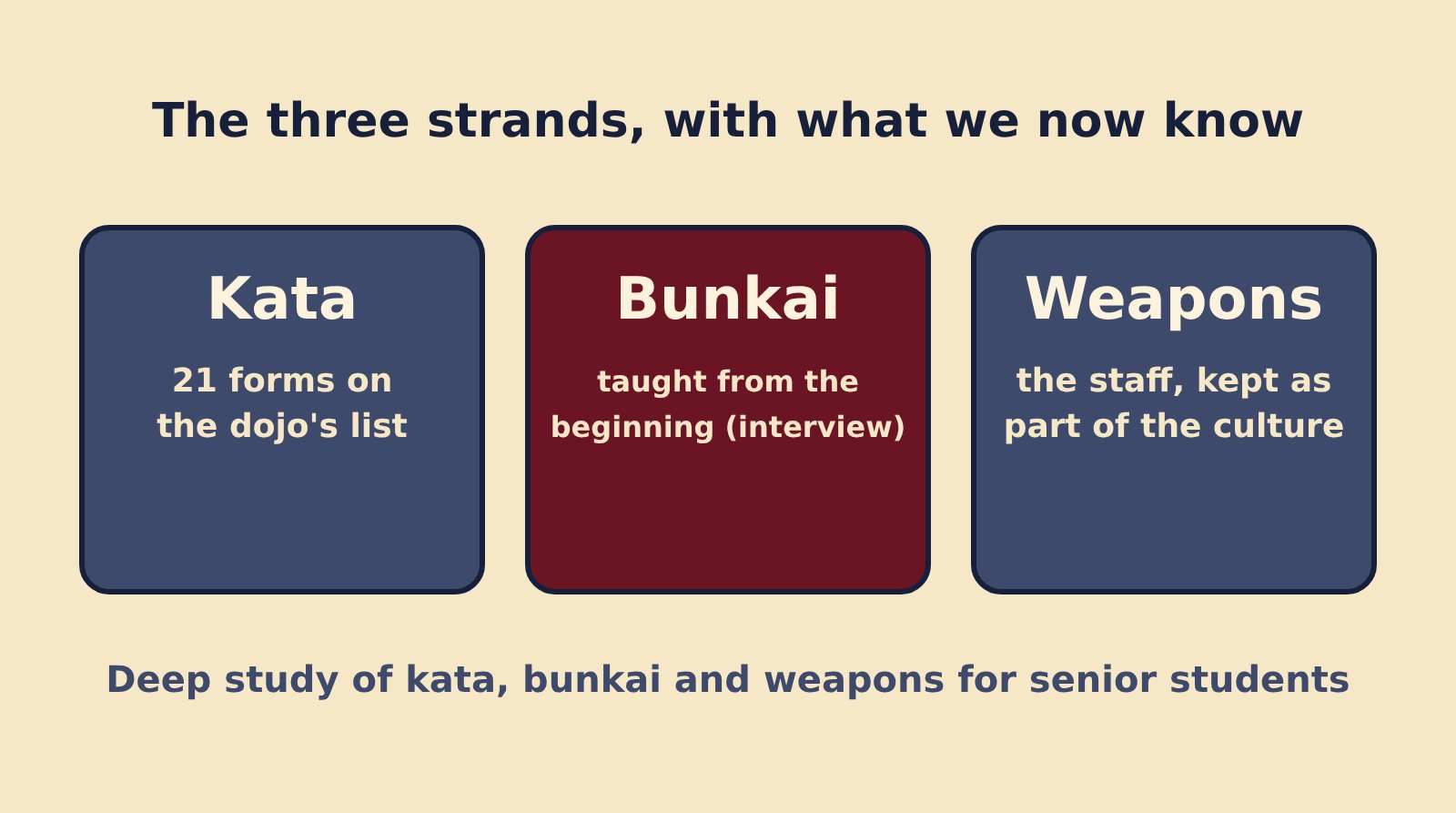
The dojo’s site lists 21 forms: Fukyugata Ichi and Ni, Pinan 1 to 5, Naihanchi 1 to 3, Seisan, Ananku, Wansu, Passai, Gojushiho, Chinto, Kusanku, Wanchin, Jion, Passai Guwa and Tokumine no Kun. In the kata list as a map we grouped them. A published interview with Supreme Sensei Zenpo Shimabukuro says his school teaches “the seven kata from Kyan sensei”, and that his father created Wanchin. For “deep study”, that matters: the list is not a flat catalogue. It has a core, a founder’s form and a staff form, and a set of forms the sources are silent about.
Bunkai: from the beginning, and not only the head
Bunkai is the study of what each movement in a kata is for, and we explained the term in what bunkai is. In the same interview, Zenpo says “we began teaching bunkai from the beginning of training”, and that “the bunkai or demonstration of what you are doing is continuously being demonstrated in my school”. He also says: “To understand what you are doing with your body is very important but more important is the body training.” And he adds that one can “think to much about bunkai” (the spelling is the interview’s). For senior students, the point is balance: understanding the application is part of the work from day one, and it does not replace the body’s training. We looked at those passages in how Seibukan is trained.
Weapons: one staff, not stressed
The program line says “weapons”, and for a long time that was all we knew. The interview narrows it. Asked about weapons, Zenpo says his school practises only the bō, a staff weapon, that the Tokumine no kun kata was given to his father by Kyan, and that “we do not stress the bo but we have kept it as part of our culture”. He adds that the bō is “very good to help with the body development of our karate”. We followed that in the staff and Tokumine no Kun. The dojo’s site adds one fact, that Sensei Prinkal Nizama holds a kobudo black belt, and nothing about how the staff is taught in Ōrākei.
The people, and the ladder
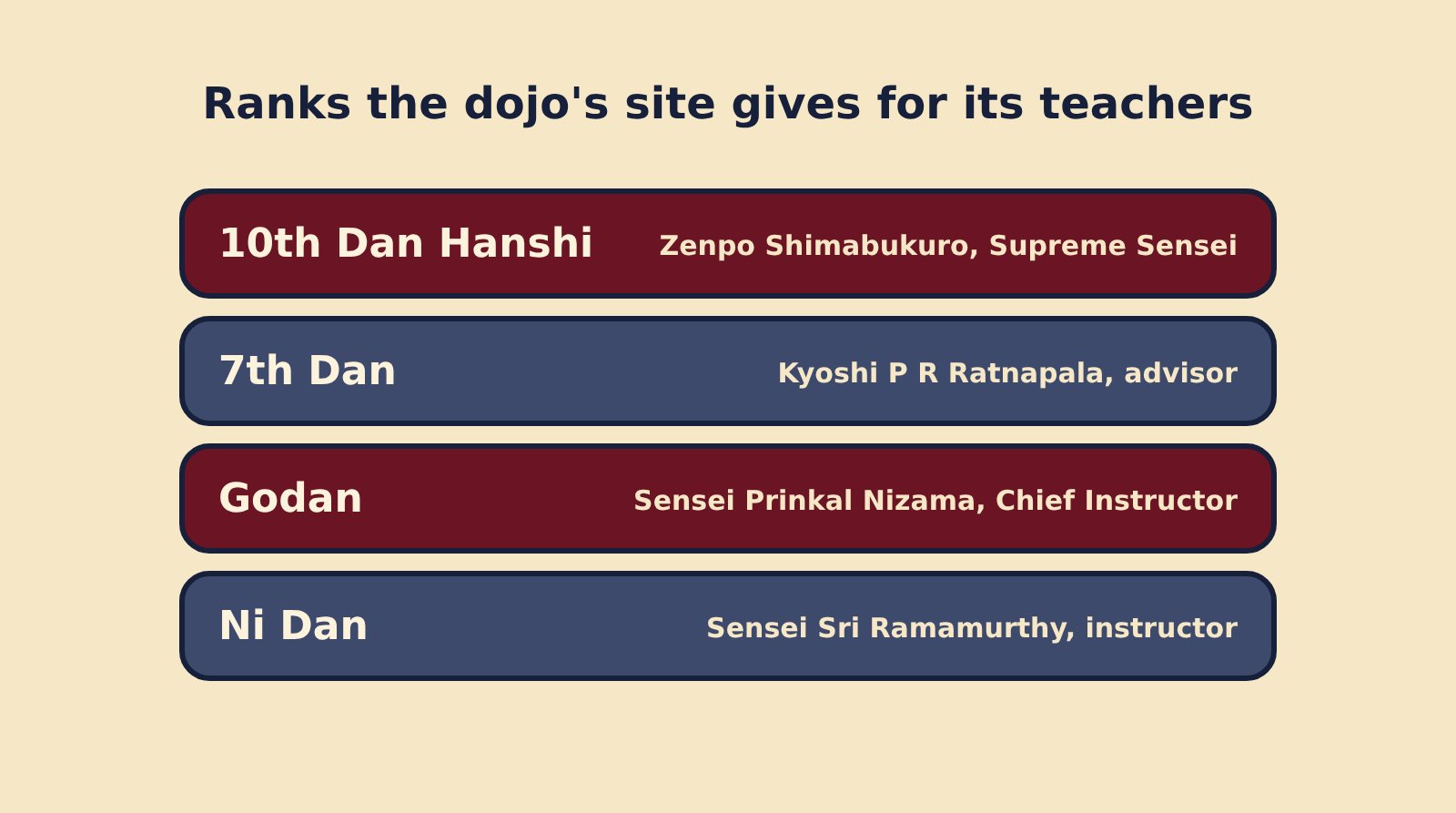
The site gives ranks for its teachers: Shimabukuro Zenpo, 10th Dan Hanshi and Supreme Sensei; Kyoshi P R Ratnapala, advisor, 7th Dan; Sensei Prinkal Nizama, Chief Instructor and Technical Director, Godan; and Sensei Sri Ramamurthy, Instructor, Ni Dan. Wikipedia’s entry on kyū explains that the dan ranks begin after 1st kyū, and that shodan, the first black belt degree, marks the move from kyū to dan. The ladder is long, and the interview’s picture of a school where seniors and newer students do not train the same way is a reminder, in our reading, that a black belt is the start of a deeper kind of study.
Questions to ask the instructors
These are our suggestions, not the dojo’s wording:
- Who counts as a senior student, and how do I know when I am ready?
- Does the program run in the regular classes or separately, and on which nights?
- What does it cost, and is it separate from the monthly fee?
- Which kata does the program focus on, and is the staff form part of it?
- How is bunkai taught at this level?
What it costs
The program has no published price. The age-based programs, for reference, are in NZD per person per month: Teens & Adults $95 for two days a week (recommended) or $65 for one, and Juniors and Seniors $85 or $55. There is a one-off $20 joining fee covering the passbook, which the dojo says lets you train at any IOSSKA dojo worldwide. The gi, badge and belt are not included, grading is charged separately, held approximately every six months, and every additional family member gets 50% off the monthly fee. Do not assume the Black Belt & Advanced price matches any of these. Ask.
If you are new
None of this is for week one. The first two classes are free, with no obligation, on Wednesdays and Fridays, 6 to 7pm, at Ōrākei Community Centre, 156 Kepa Road. Wear comfortable clothes you can move in, arrive 10 minutes early, and tell the instructors about any injury or health condition. The current term runs from 7 October to 18 December. Call 029 128 0873 or fill in the form.
Frequently asked questions
What is the Black Belt and Advanced program?
The dojo describes it as “Deep study of Seibukan kata, bunkai and weapons for senior students”. The site gives no price, timetable or entry requirement.
What weapons does Seibukan practise?
In an interview, the Supreme Sensei says his school practises only the bō, a staff weapon, and that it is not stressed but has been kept as part of the school’s culture.
Is bunkai taught from the start?
According to the same interview, yes: bunkai is taught from the beginning of training. He also says body training matters more than understanding alone.
What does the program cost?
The site gives no price. Ask the instructors, and do not assume it matches the age-based programs.
When are the classes?
Wednesdays and Fridays, 6 to 7pm, at Ōrākei Community Centre. The site does not say whether the program runs in those slots. The first two classes are free.
Sources
- IOSSKA-NZ, seibukan.co.nz: the program line, kata list, instructor ranks, class times, pricing and booking (checked November 2026).
- The Karate of Chotoku Kyan: Interview with the Seibukan’s Zenpo Shimabukuro, Dragon Times: kata from Kyan, Wanchin, bunkai, body training and the bō. Read for these passages only.
- Kyū, Wikipedia: how kyū and dan ranks relate.
Curious? Your first two classes are free: Wednesdays and Fridays, 6 to 7pm, at Ōrākei Community Centre. Call now or fill in the form.