Sometimes the reason you want to start something is not fitness. It is that your head is too full. Work follows you home, sleep is patchy, and you would like an hour a week when you are not thinking about any of it. Karate, with its repeated movements and its set routines, is one of the things people try for exactly that reason.
The IOSSKA-NZ dojo at the Ōrākei Community Centre, 156 Kepa Road, describes its Teens & Adults class this way: “Traditional kata, kihon and kumite. Get fit, de-stress and learn real self-defence, with a clear path to black belt.” This post looks honestly at the “de-stress” part. It covers what New Zealand health sources say about movement and mood, what they do not say, what a class cannot do, and what to ask. Dojo facts are from its own site, checked in November 2026.
What the dojo says
The word “de-stress” is in the program line, and that is all the site says about it. It does not describe a calming component, a particular pace, or any wellbeing program. The site also names respect and discipline as central to its karate, and says classes are beginner-friendly and you train at your own pace. So the claim is a modest one, and it is the dojo’s own.
What the health sources say
Health NZ’s page on being physically active says “doing any physical activity is good for your health”, that activities you enjoy, especially with others, can make it easier to stay active, and that physical activity can help you manage anxiety, depression and stress.
The Mental Health Foundation’s guide to starting physical movement says “physical movement can be an uplifting experience – it releases endorphins which can lift our mood”, and that people tended to feel more content and calm after exercise, especially if they started out anxious or low. It is also gentle about how to begin: “it’s best to start slow and simple”, “you can take things slowly”, and “you don’t have to exercise to exhaustion to enjoy the benefits of moving your body”.
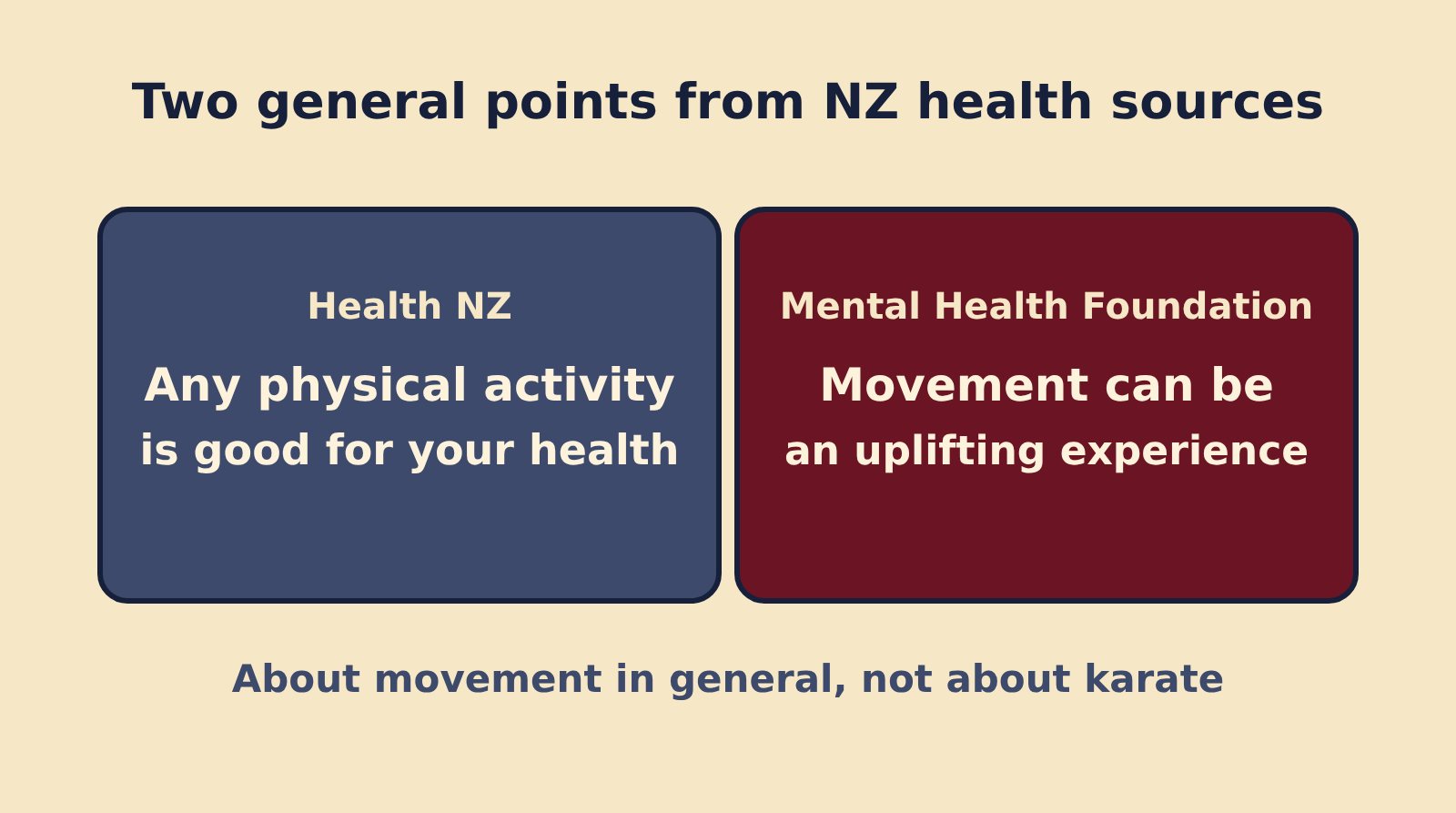
None of those sources mention karate. They are about movement in general, and we are not claiming that a karate class will lift your mood, only that it is one way to move, with other people, on a regular night.
Why a class might suit a full head
This is our reading, not the dojo’s or a source’s. Karate training is built on kihon, the basics, which Wikipedia says tend to be practised often, “in many cases during each practice session”, and on kata, set sequences of movement. A routine you repeat, in a room with a clear start and end time, asks for your attention in a way that scrolling does not. Some people find that restful. Others find that learning something new is more stressful at first, not less, and that is normal too.
What a class cannot do
A class is not a treatment. If you are struggling with anxiety, low mood or stress that will not lift, the first step is to talk to your GP or another health professional. The HealthEd leaflet Be active every day says to “talk to your doctor or nurse if it’s been a long time since you were active or if you have any health problems”.
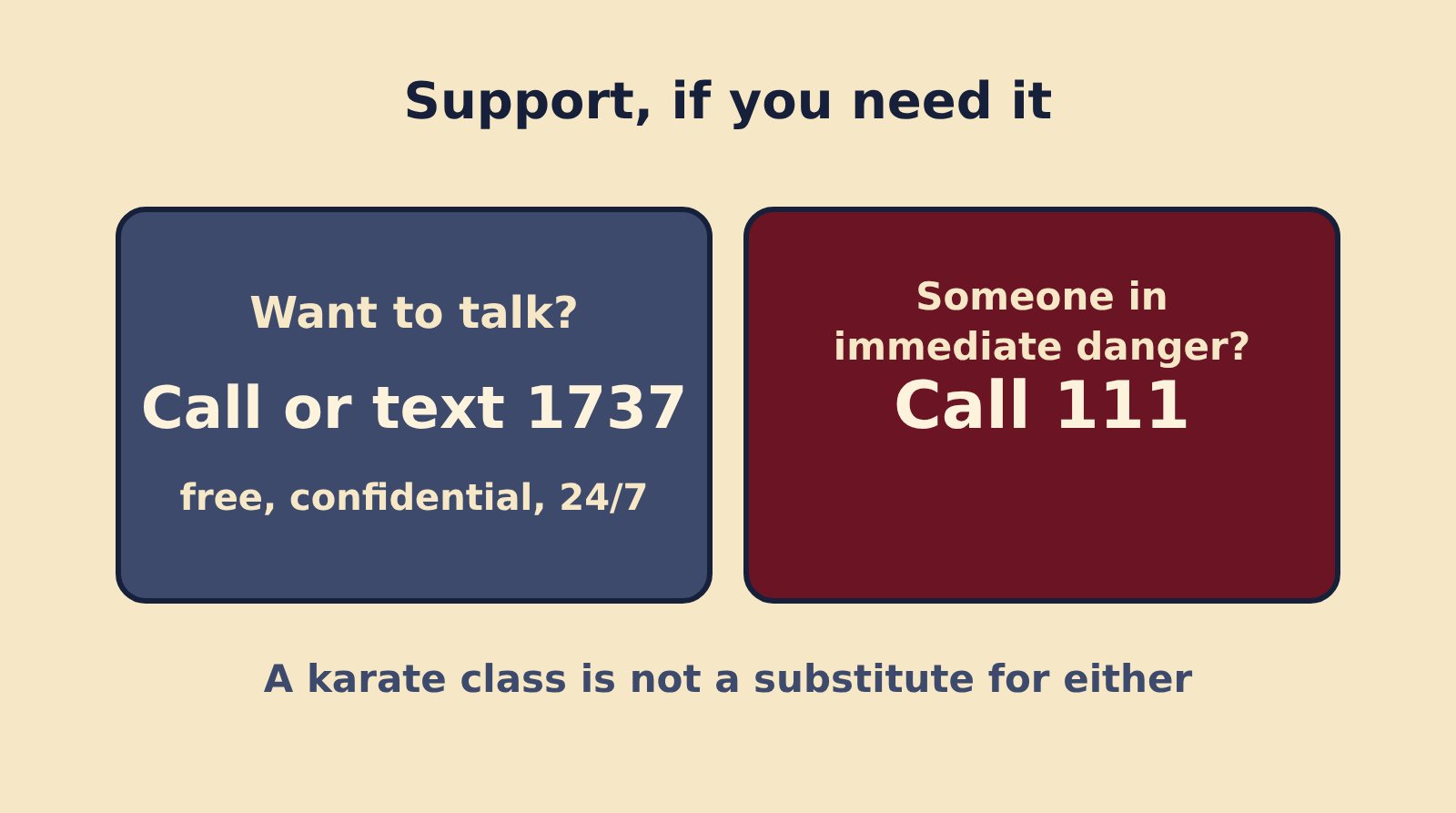
If you need to talk to someone now, 1737 describes itself as free, confidential support, 24 hours a day, by call or text, answered by trained counsellors and peer support workers. If someone is in immediate danger of harming themselves or others, call 111.
Questions to ask the instructors
These are our suggestions, not the dojo’s wording:
- How is a first class paced for someone who is anxious or tired?
- Can I watch a class before I join in?
- What happens if I need to stop part-way through?
- Is partner practice optional at the start?
The dojo asks you to tell the instructors about any injury or health condition before class so they can train you safely. That conversation is a good place to say how you are feeling, as far as you want to.
What it costs
All prices are from the dojo’s site, in NZD, per person, per month.
| What | Cost |
|---|---|
| First 2 classes | Free, with no obligation |
| Teens & Adults, 2 days a week (Wednesday and Friday), recommended | $95 per month |
| Teens & Adults, 1 day a week (Wednesday or Friday) | $65 per month |
| Joining fee | $20, one-off, covers your passbook |
| Gi, badge and belt | Not included |
| Grading | Charged separately, held approximately every 6 months |
The dojo says one day a week gives slower progress, and students can switch between plans. For someone who wants a gentle start, one night is a sensible place to begin, as we explain in one night or two.

How to try it
- Book. Call 029 128 0873 or fill in the booking form. You can choose “Just researching” if you are not sure yet.
- Wear comfortable clothes you can move in. You do not need a uniform for trial classes.
- Arrive 10 minutes early on a Wednesday or Friday, 6 to 7pm. The current term runs from 7 October to 18 December, and bookings for next year will be announced shortly.
For the whole program, see karate for teens and adults at the Ōrākei dojo.
Frequently asked questions
Will karate help with stress?
The dojo’s one-line description includes “de-stress”. Health NZ says physical activity can help you manage anxiety, depression and stress, and the Mental Health Foundation says movement can lift mood. Neither mentions karate, so we make no claim that a class will help you.
Is karate a treatment for anxiety or depression?
No. If you are struggling, talk to your GP or another health professional. 1737 offers free, confidential support by call or text, 24 hours a day, and in immediate danger you should call 111.
Do I need to be fit to start?
The dojo says classes are beginner-friendly and you train at your own pace. If you have been inactive for a long time, HealthEd advises starting slowly and talking to your doctor or nurse.
How much does it cost?
The first two classes are free. After that it is $95 a month for two days a week (recommended) or $65 for one day, plus a one-off $20 joining fee. The gi, badge and belt are extra, and grading is charged separately.
When are the classes?
Wednesdays and Fridays, 6 to 7pm, at Ōrākei Community Centre, 156 Kepa Road. The current term runs from 7 October to 18 December.
Sources
- IOSSKA-NZ, seibukan.co.nz: the Teens & Adults program line, class times, venue, pricing, safety wording and booking (checked November 2026).
- Being physically active, Health NZ: benefits of activity, including anxiety, depression and stress.
- A guide to starting physical movement, Mental Health Foundation of New Zealand: movement and mood, starting gently.
- Be active every day: physical activity for adults, HealthEd: starting slowly, talking to a doctor or nurse.
- 1737, Need to talk?: free, confidential support by call or text.
- Kihon and Kata, Wikipedia: term meanings only.
Ready to try it? Your first two classes are free: Wednesdays and Fridays, 6 to 7pm, at Ōrākei Community Centre. Call now or fill in the form.