The booking form does not ask how often you want to train, but the first call will. Wednesday and Friday, or just one of them? The dojo has a view, and so does your diary and your budget. This post sets out what the second night costs, what the dojo says about it, and what health guidance suggests, so you can decide before the instructor rings.
Everything about the dojo is from the IOSSKA-NZ site, checked in November 2026. The per-class figures are our arithmetic from its prices, not a quote.
What the dojo says
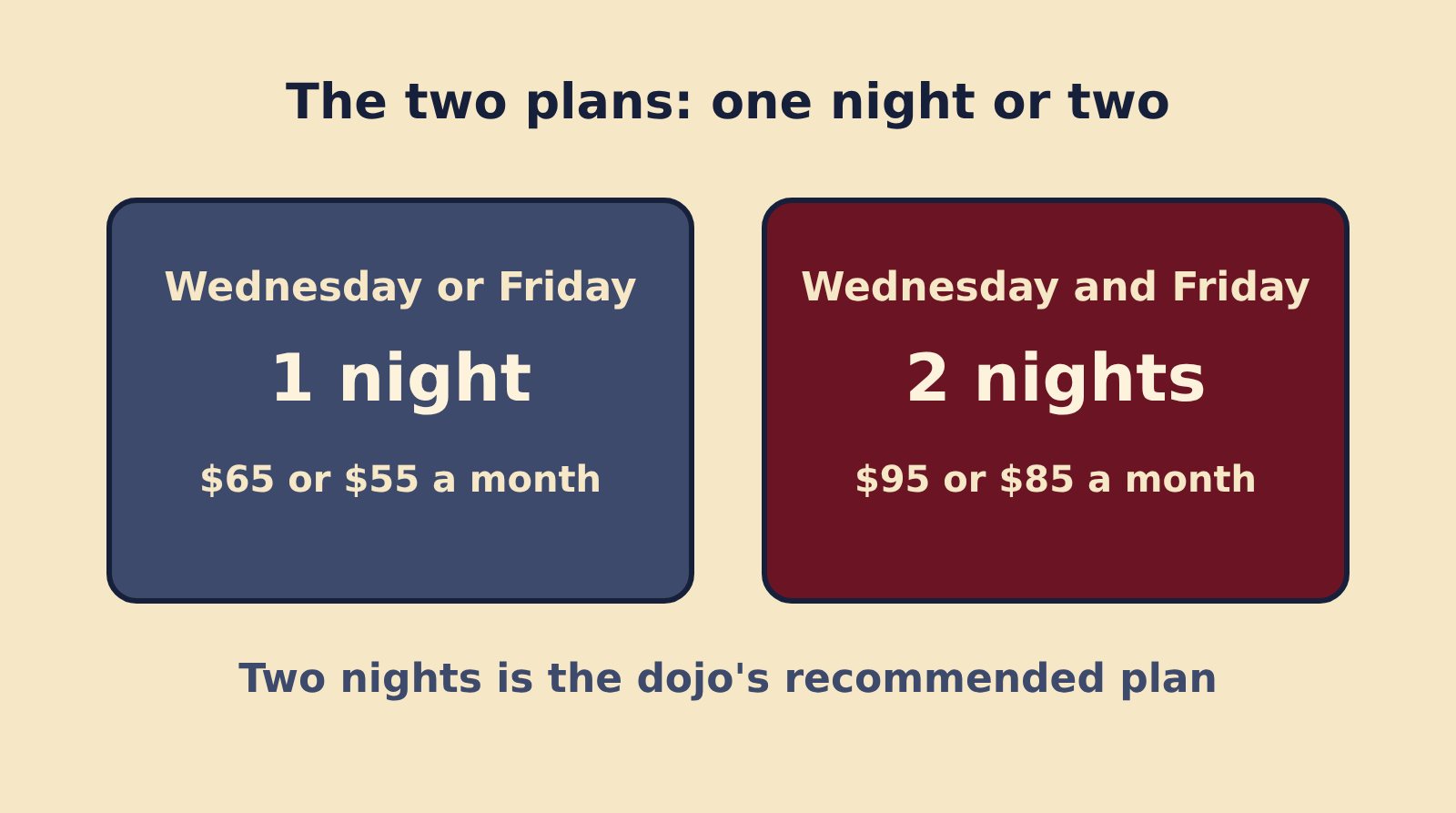
The site offers two plans, and states a preference. Two days a week, Wednesday and Friday, is the plan it recommends. Its advice is “Choose 2 days a week for the best results, or 1 day if your schedule is tight”. It says training one day a week “gives slower progress”, and it does not say how much slower. It also says students can switch between the plans, so the choice is not permanent.
What the second night costs
All prices are per person, per month, in NZD.
| Program | 1 night a week | 2 nights a week | Difference |
|---|---|---|---|
| Teens & Adults (15 to 64) | $65 | $95 | $30 |
| Juniors (7 to 14) | $55 | $85 | $30 |
| Seniors (65+) | $55 | $85 | $30 |
In every program, the second night adds $30 a month. That is the whole of the arithmetic, and it is the part that does not depend on any assumption.
What that is per class
A year has about 4⅓ weeks to a month (52 weeks divided by 12), so one night a week is roughly 4⅓ classes a month and two nights is roughly 8⅔. Divide the fee by the classes and you get a rough price per class:
| Program | 1 night: per class | 2 nights: per class |
|---|---|---|
| Teens & Adults | about $15.00 | about $10.96 |
| Juniors, Seniors | about $12.69 | about $9.81 |
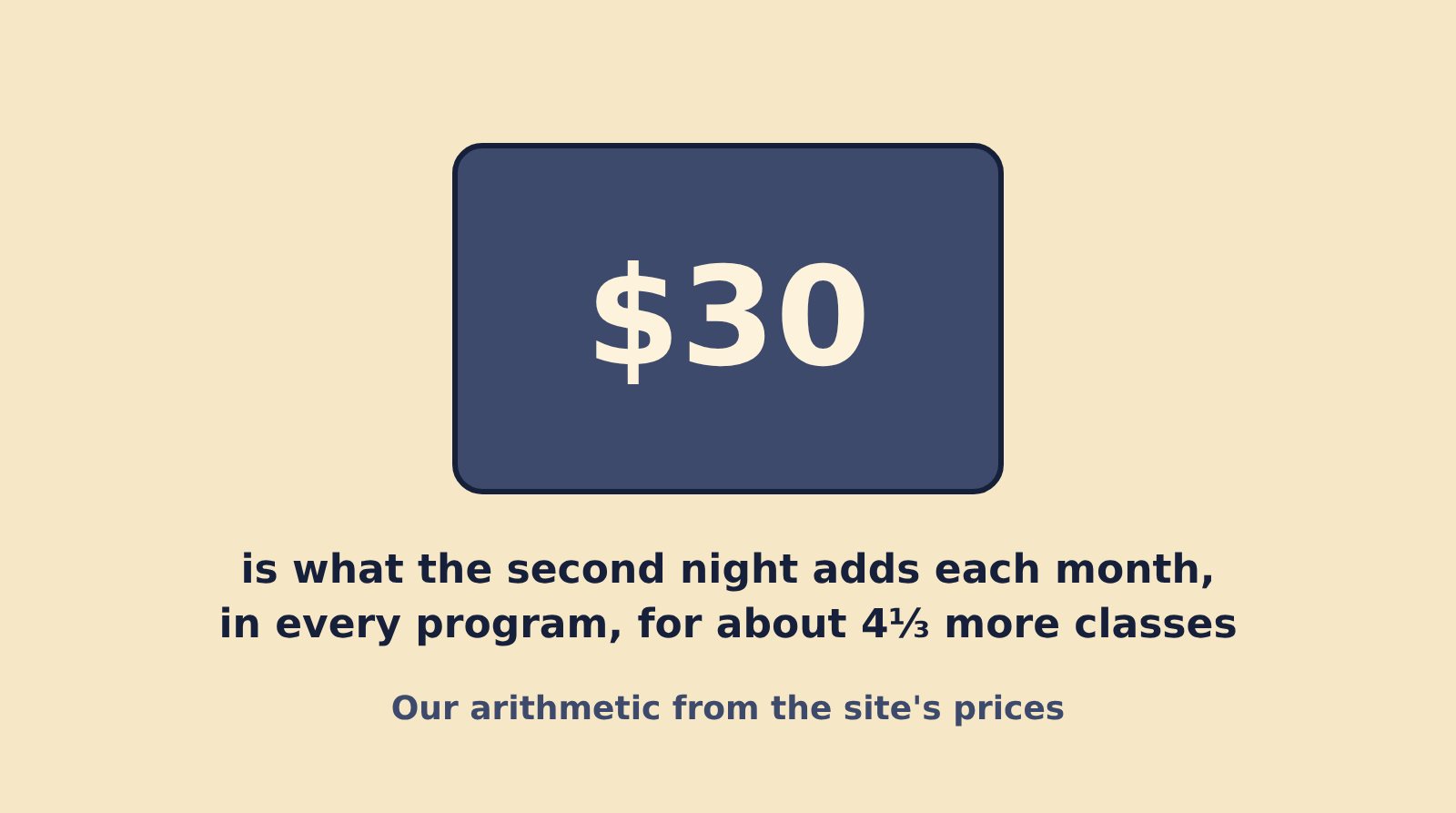
The second night, taken alone, works out at about $6.92 a class ($30 divided by 4⅓). So each extra class costs less than half of what a class costs on the one-night plan for a Teens & Adults student. This is a rough figure. The current term runs from 7 October to 18 December and the site does not list gaps, but not every week of the year will have classes, and it does not say whether every month is billed. Treat the numbers as a guide and confirm billing with the instructors.
What health guidance suggests
None of these sources mention karate, and we are not claiming a class meets any target. They do show how the hours stack up.
- Adults. The HealthEd leaflet Be active every day says to “do at least 2½ hours of moderate or 1¼ hours of vigorous physical activity spread throughout the week”. One class a week is one hour, and two is two hours, so two nights gets closer but does not reach it on its own.
- Children and teenagers. Sit less, move more, sleep well says “at least one hour of moderate to vigorous physical activity each day” for ages 5 to 17. Even two classes a week is a small share of that, so it works best as one part of an active week.
- Older people. Health NZ’s page on being physically active says older people who are not frail should “start off slowly and build up”. Starting with one night and adding a second later fits that advice.
How to choose
These are our suggestions, not the dojo’s rules:
- Start with one night if you have been inactive for a while, you have an injury to manage, you are a parent juggling several evenings, or you simply want to see how it feels.
- Start with two nights if you want the dojo’s recommended pace and the schedule allows. The extra $30 buys about 4⅓ more classes a month.
- Try both in the free classes. The first two classes are free, so one on Wednesday and one on Friday is a way to test both nights before you pay.
If you start on one night, you can switch. Our post on what a year of karate costs shows the yearly totals for each plan.

If your week changes
Few people keep the same schedule all year. Exams, shift work, a new baby or a bad winter can make two nights impossible for a while, and a quiet stretch can make them easy again. Because the site says students can switch plans, you are not choosing a lifestyle, only a pace for now. If you do switch, tell the instructors, and ask whether the change takes effect straight away or from the next month.
What else is not in the fee
On top of the monthly fee there is a one-off $20 joining fee that covers a passbook, which the dojo says lets a student train at any IOSSKA dojo worldwide. The gi, badge and belt are not included, and grading is charged separately, held approximately every six months. Every additional family member gets 50% off the monthly fee, on either plan.
How to try it
- Book. Call 029 128 0873 or fill in the booking form. Say which nights suit you, or that you want to try both.
- Wear comfortable clothes you can move in. You do not need a uniform for trial classes.
- Arrive 10 minutes early on a Wednesday or Friday, 6 to 7pm, at Ōrākei Community Centre, 156 Kepa Road. The current term runs from 7 October to 18 December, and bookings for next year will be announced shortly.
Frequently asked questions
Should I train one day or two days a week?
The dojo recommends two days a week for the best results and says one day gives slower progress. If your schedule is tight, one day is available, and students can switch between the plans.
How much does the second night cost?
$30 a month in every program: Teens & Adults is $65 for one day and $95 for two, and Juniors and Seniors are $55 and $85. That works out at about $6.92 a class, our arithmetic.
Can I switch plans later?
Yes. The site says students can switch between the one-day and two-day plans.
Can I try both nights first?
The first two classes are free, with no obligation, so you could come on a Wednesday and a Friday. Ask the instructor when you book.
When are the classes?
Wednesdays and Fridays, 6 to 7pm, at Ōrākei Community Centre, 156 Kepa Road. The current term runs from 7 October to 18 December.
Sources
- IOSSKA-NZ, seibukan.co.nz: the two plans, prices, the dojo’s advice on one day or two, switching, joining fee, family discount and term dates (checked November 2026). All per-class figures are our arithmetic.
- Be active every day: physical activity for adults, HealthEd: weekly aim for adults.
- Sit less, move more, sleep well, HealthEd: daily aim for ages 5 to 17.
- Being physically active, Health NZ: older people starting slowly.
Ready to try both nights? Your first two classes are free: Wednesdays and Fridays, 6 to 7pm, at Ōrākei Community Centre. Call now or fill in the form.