Many dojos talk about respect, and a few months into training the question comes back: what does it actually ask of you? When your dojo says respect is at the centre of its karate, what does that mean in the middle of the third repetition of a technique you are tired of, or when the person across from you is a beginner and you are not?
This post looks at respect in a Seibukan class from the inside out, using what the IOSSKA-NZ dojo says on its own site, what a published account of the Seibukan hombu (headquarters) dojo in Okinawa describes, and a plain reference on what a dojo is. We keep to what we could read, and we mark where the sources stop. Dojo facts are from its own site, checked in October 2026.
What the dojo says
The dojo’s FAQ says “Respect and discipline are at the centre of Seibukan karate”. Its homepage quotes the Supreme Sensei, Shimabukuro Zenpo, on what karate is for: “karate is not a sport. Real self-defence, focus and self-belief.” We look at that line closely in why karate is not a sport.
Notice what that sentence leaves out. There is no trophy, no ranking against other people, nothing to win from someone else. If the purpose of training is focus and self-belief, then the person you are measured against is yourself on an earlier day. That changes what respect means in the room. It is not deference to whoever is stronger. It is attention to the people who are helping you get better, including the ones who are less experienced than you.
A place with a name
The word dojo carries an idea in its own name. Wikipedia’s entry describes a dōjō as “a hall or place for immersive learning, experiential learning, or meditation”, and says the term literally means “place of the Way” in Japanese. The same entry notes that footwear is not worn inside, in keeping with Japanese custom of keeping the premises clean.
The Ōrākei class meets in a community centre hall, not a purpose-built dojo, and the dojo’s site does not describe its entry customs, how students greet the instructors or when they bow. We will not guess. What the name does tell you is that the space is meant for learning, and that looking after it, arriving on time and arriving ready is part of the practice, not a preliminary to it. The site asks newcomers to arrive 10 minutes early for a welcome and a walk through the basics, which is a small version of the same idea.
Respect as effort
An article on Budo Japan describes a visit to the Seibukan hombu dojo in Okinawa, led by Zenpo Shimabukuro. Its most striking passages on respect are about effort rather than manners. It quotes him on training: “we should not complain during training… It’s all about effort.” The author says the dojo’s attitude to effort shows in how everyone trains: “everyone was giving their best effort to progress”. It also records that the dojo’s precepts are displayed on the wall, and that one reads “To cultivate the spirit of effort.”
The same article describes children and adults training together in the basics and kata, and calls it a space where “every possible generation” is connected by dedication to karate. We have read it for these passages only. It is one visitor’s account of the hombu dojo, not a description of Ōrākei, but it shows what the lineage means by the word.
In this reading, respect is something you do with your effort. Turning up when the weather is poor, working through the repetition without complaint and giving the same attention to the tenth attempt as the first are all ways of respecting the teacher, the lineage and the people training beside you.
Respect for the line you belong to
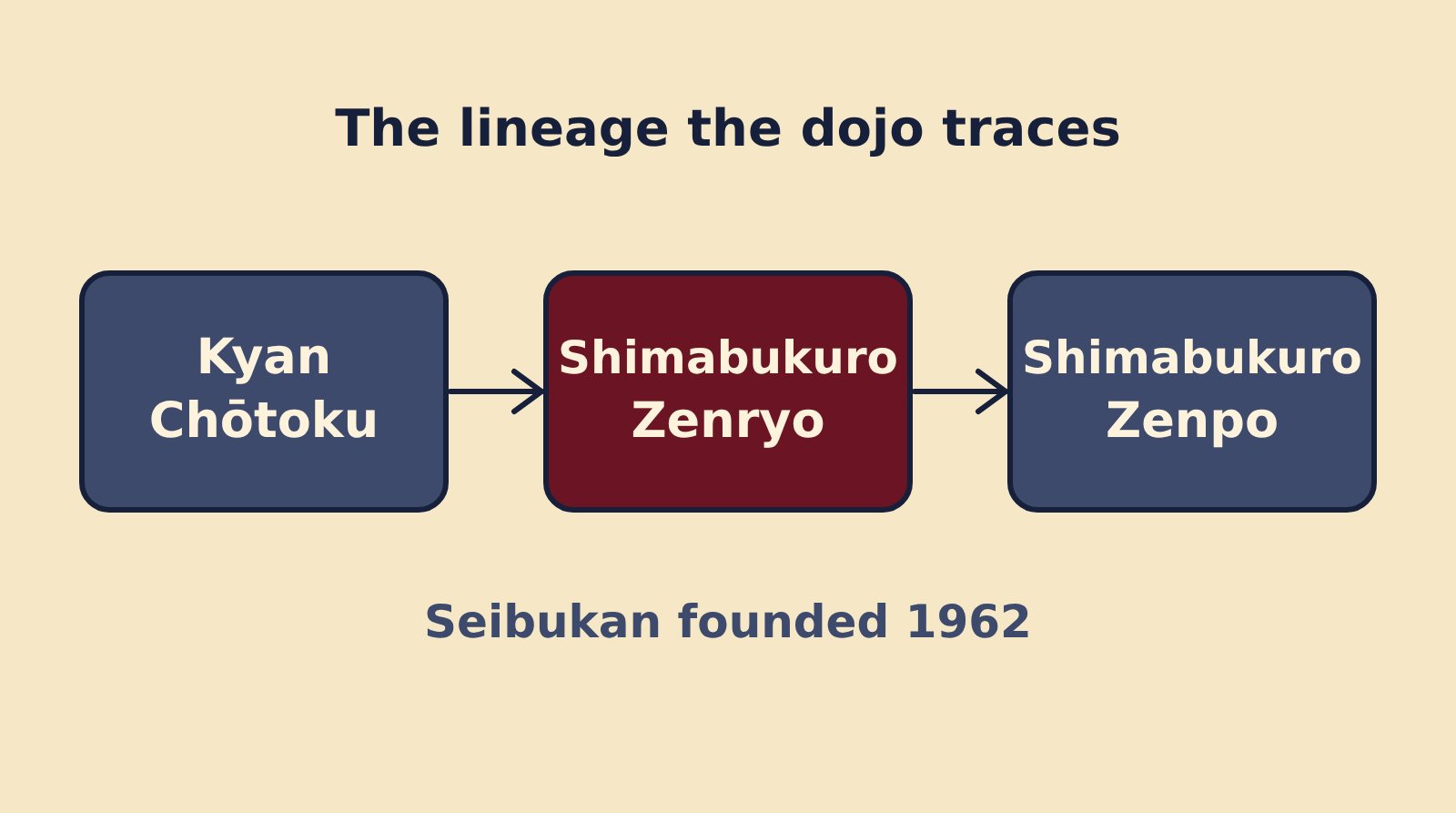
The dojo’s site records a lineage of three names. Kyan Chōtoku, born in Shuri in Okinawa, learned from six masters and created the kata Ananku. His direct student Shimabukuro Zenryo resumed teaching after the war and founded Seibukan at his home dojo in 1962. Zenryo’s son, Zenpo, now leads the IOSSKA with his own son, Zenshun. We tell the stories in more detail in who Kyan Chōtoku was and how Seibukan was founded.
What that gives a student is context. When you practise a kata you are doing something that was passed from person to person, and the kata syllabus the dojo lists includes Ananku, the form the site credits to Kyan. Respect for the lineage is knowing that your next repetition is a link in a chain, and that you are responsible for handing it on in good shape. The passbook that every member receives for the $20 joining fee, which the dojo says lets you train at any IOSSKA dojo worldwide, is a practical reminder that you belong to something larger than one hall.
Respect for the person next to you
The simplest form of respect is also the most practical: look after each other. The dojo asks every student to “tell us about any injury or health condition before class so we can train you safely”. That one line shows respect running in both directions. The instructors respect you enough to adjust, and you respect your training partners enough to tell them what they need to know before they work with you.

For senior students, the harder respect is for beginners. A new student cannot yet do what you do, and may not yet know the words. Slowing down for them, explaining a term without making them feel small, and treating their first attempt with the seriousness you want for your own is what the dojo’s description of itself as disciplined and supportive asks of everyone, not only of the instructors.
What we cannot tell you
The site does not publish a formal dojo kun, the written creed some dojos recite. It names respect as central and leaves the details to the instructors. So we cannot tell you how the Ōrākei class opens or closes, how students address one another, or what the customs are for a visitor. If you want to know, the people to ask are the instructors, and a trial class is the right time to ask.
- How do students greet the instructors when they arrive, and does a newcomer need to do anything?
- What is expected of a visitor who wants to watch a class?
- How do senior students help beginners in a class?
If you are new
You do not need to know any of this to begin. The first two classes are free, with no obligation, on Wednesdays and Fridays, 6 to 7pm, at Ōrākei Community Centre, 156 Kepa Road. Wear comfortable clothes you can move in, with no uniform needed for trial classes, and arrive 10 minutes early. The current term runs from 7 October to 18 December. Plans are $95 a month for Teens & Adults for two days a week or $65 for one day, and $85 or $55 for Juniors and Seniors, plus a one-off $20 joining fee. The gi, badge and belt are extra and grading is charged separately, about every 6 months.
Frequently asked questions
What does respect mean in a karate class?
The dojo says respect and discipline are at the centre of its karate. Sources on the Seibukan lineage describe it largely as effort: training without complaint and giving your best in every repetition.
Is bowing required?
The dojo’s site does not describe bowing or other entry customs, so we cannot say. Ask the instructors when you book your first class.
Does the dojo have a written dojo kun?
The IOSSKA-NZ site does not publish one. An article about the hombu dojo in Okinawa says its precepts are displayed on the wall, but we have not seen the Ōrākei wording.
Why does the dojo say karate is not a sport?
The site quotes the Supreme Sensei: “karate is not a sport. Real self-defence, focus and self-belief.” With no contest to win, the measure is your own progress, which changes what respect means.
Do I need to tell the instructors about an injury?
Yes. The dojo asks you to tell the instructors about any injury or health condition before class so they can train you safely.
Sources
- IOSSKA-NZ, seibukan.co.nz: respect and discipline, the Supreme Sensei’s words, lineage, kata syllabus, passbook, class times, pricing and safety wording (checked October 2026).
- Immersion in the ways of Okinawan power: visit to Zenpo Shimabukuro’s Dōjō, Budo Japan: effort, the precepts on the wall, children and adults training together. Read for these passages only.
- Dōjō, Wikipedia: meaning of the word and the custom on footwear.
Curious? Your first two classes are free: Wednesdays and Fridays, 6 to 7pm, at Ōrākei Community Centre. Call now or fill in the form.