
You are a few weeks into the term, or you are about to join one, and you want to know what you are actually signing up for. Not the price, which is easy to find, but the shape of it. How many classes is a term? What will you have worked through by the end? What should you be able to do in December that you cannot do now?
This post answers the first question exactly, because the dojo’s site gives the dates, and answers the others as far as the site allows. It is written for members and for anyone weighing up a start. Dojo facts are from its own site, checked in October 2026.
The dates
The IOSSKA-NZ site says the current term runs from 7 October to 18 December, with the first class on 7 October. Classes are at Ōrākei Community Centre, 156 Kepa Road, on Wednesdays and Fridays, 6 to 7pm. It says bookings for next year “will be announced shortly”, so the dates of the next term, and the length of the break between the two, are not yet published.
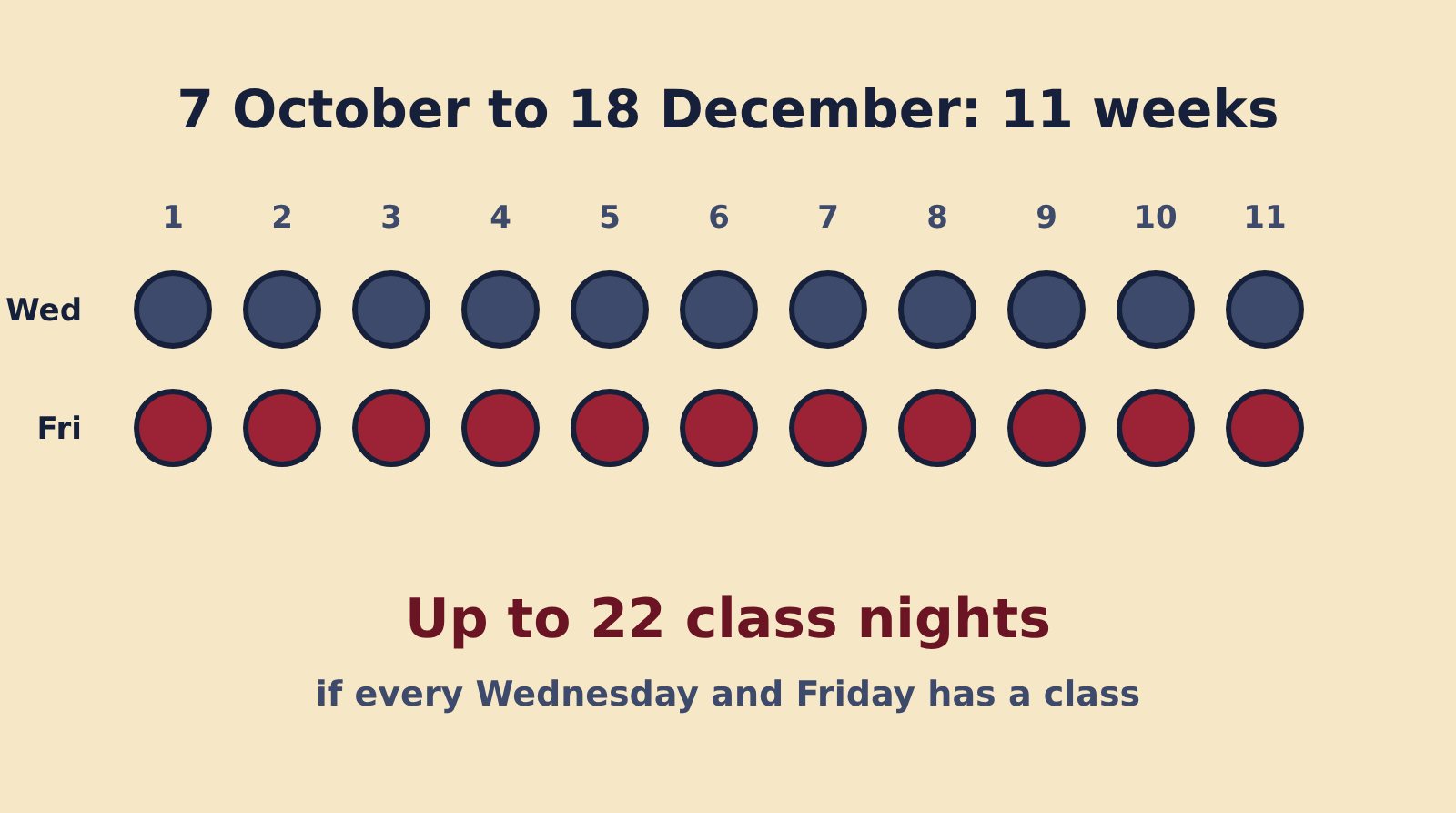
Counting from the calendar, 7 October is a Wednesday and 18 December is a Friday. That gives eleven Wednesdays and eleven Fridays.
The arithmetic
If every Wednesday and Friday in that span has a class, the term holds up to 22 class nights. A student on the two-day plan, which the dojo recommends, could attend all 22. A student on the one-day plan could attend up to 11. Each class is an hour, so the totals are up to 22 hours and up to 11 hours across the term.
The word “up to” matters. The site does not promise a class every night, and it does not list holiday gaps, so confirm the term calendar with the instructors if you are planning around it. The dojo says its gradings are held approximately every six months, and does not say how a grading lines up with a term, so we will not guess that either.
What the hour is made of
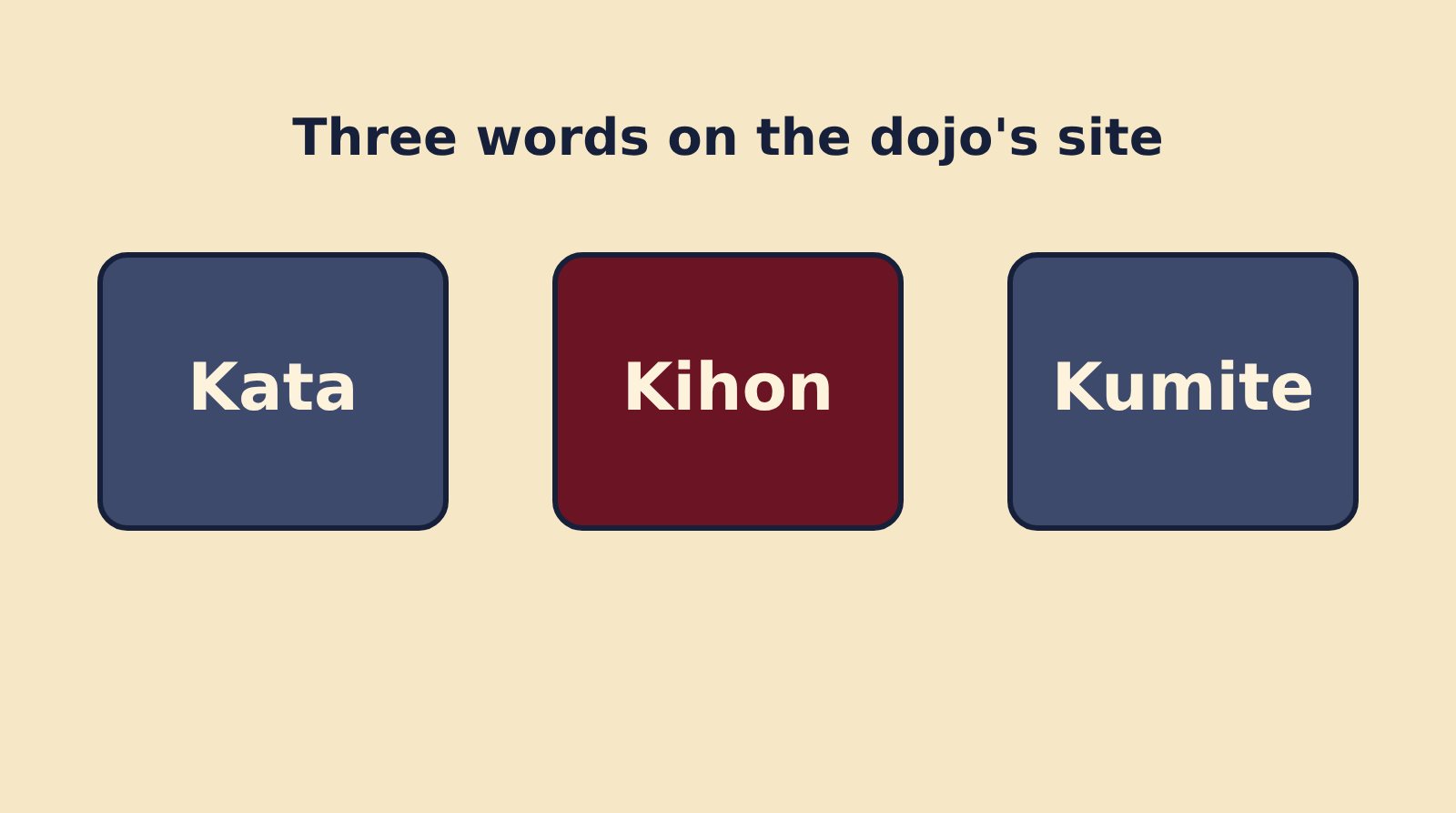
The dojo’s one-line description of the Teens & Adults program is “Traditional kata, kihon and kumite. Get fit, de-stress and learn real self-defence, with a clear path to black belt.” Those three Okinawan words are the closest the site gets to a syllabus for the hour:
- Kihon means “basics” or “fundamentals”. Wikipedia says kihon techniques “tend to be practiced often, in many cases during each practice session”, and that kihon is “essential to all advanced training”.
- Kata are set sequences of movement, practised alone. Wikipedia calls a kata “a detailed choreographed pattern of martial arts movements”.
- Kumite is practice with a partner.
Beyond that, the site does not say how an hour is divided, what a beginner does in week one compared with week eleven, or whether each term has a theme. We would rather say that plainly than invent a week-by-week plan.
The body of material
What the site does publish is the list of kata the dojo teaches: Fukyugata Ichi and Ni, Pinan 1 to 5, Naihanchi 1 to 3, Seisan, Ananku, Wansu, Passai, Chinto, Kusanku, Wanchin, Jion, Passai Guwa and Tokumine no Kun, with others on the full list. It does not say which belong to which grade, or how many a student works through in a term.
That list tells you a term is a slice of something long. Our post on tanren describes how an account of Seibukan training treats repetition, with the same exercises done again and again until unnecessary movement is removed. Read that way, a term is not a unit of content to be finished. It is eleven weeks of practice on material you will return to for years, and what changes is you.
Questions worth asking
These are our suggestions, not the dojo’s wording, and the instructors are the right people to answer them:
- What will a beginner have worked on by the end of this term?
- Which kata should a new student expect to learn first?
- How does a grading connect to the term, and when is the next one?
- Are there class nights that are different, such as a grading or a visit?
- What happens over the break, and when will next year’s bookings open?

Getting the most out of the nights you have
Two things follow from the arithmetic, and both are our reading, not the dojo’s. First, the dojo’s own advice is that two days a week gives the best results and one day gives slower progress, so if you can manage both nights, the numbers above show what you gain: up to eleven more hours in a term. Second, because the nights are limited, turning up regularly and arriving on time matters more than any one class. The site asks newcomers to arrive 10 minutes early for a welcome and a walk through the basics.
If you have an injury or a health condition, the dojo asks you to tell the instructors before class so they can train you safely.
What it costs
All prices are from the dojo’s site, in NZD, per person, per month. They are monthly, not per term.
| What | Cost |
|---|---|
| First 2 classes | Free, with no obligation |
| Teens & Adults, 2 days a week (recommended) / 1 day a week | $95 / $65 per month |
| Juniors and Seniors, 2 days a week (recommended) / 1 day a week | $85 / $55 per month |
| Joining fee | $20, one-off, covers your passbook |
| Family discount | 50% off the monthly fee for every additional family member, on either plan |
| Gi, badge and belt | Not included |
| Grading | Charged separately, held approximately every 6 months |
Students can switch between the one-day and two-day plans. If you are new, try the free classes first: wear comfortable clothes you can move in, with no uniform needed for trial classes.
Frequently asked questions
How long is a term?
The current term runs from 7 October to 18 December, eleven weeks. Classes are on Wednesdays and Fridays, 6 to 7pm, so a term holds up to 22 class nights if every one has a class.
What does a term cover?
The dojo’s site does not publish a term syllabus. It describes the training as kata, kihon and kumite and lists the kata it teaches. Ask the instructors what a beginner works on in a term.
Can I join part-way through a term?
The site offers two free classes with no obligation, and does not say whether there is a cut-off for joining mid-term. Contact the dojo to confirm how joining mid-term works.
Is the fee per term or per month?
Per month. Teens & Adults is $95 for two days a week or $65 for one day, and Juniors and Seniors are $85 or $55, plus a one-off $20 joining fee.
When does the next term start?
The site says bookings for next year will be announced shortly. No dates are published yet.
Sources
- IOSSKA-NZ, seibukan.co.nz: term dates, class times, venue, program description, kata list, pricing, grading and safety wording (checked October 2026).
- Kihon, Kata and Kumite, Wikipedia: term meanings only.
Want to see a term from the inside? Your first two classes are free: Wednesdays and Fridays, 6 to 7pm, at Ōrākei Community Centre. Call now or fill in the form.