

Sooner or later, every new student asks it. When do I get my next belt? For a child it is the question after “can we go again?”. For an adult it is often asked quietly, after a few weeks, when the early awkwardness has worn off and you start to want a marker of progress.
Belts and grading are easy to explain in general and harder to pin down for one particular dojo. This post covers both: how the kyū and dan system works in plain words, what the IOSSKA-NZ dojo in Ōrākei says about its own gradings, and, just as important, what its site does not yet say. Dojo facts are from its own site, checked in October 2026.
Kyū and dan in plain words
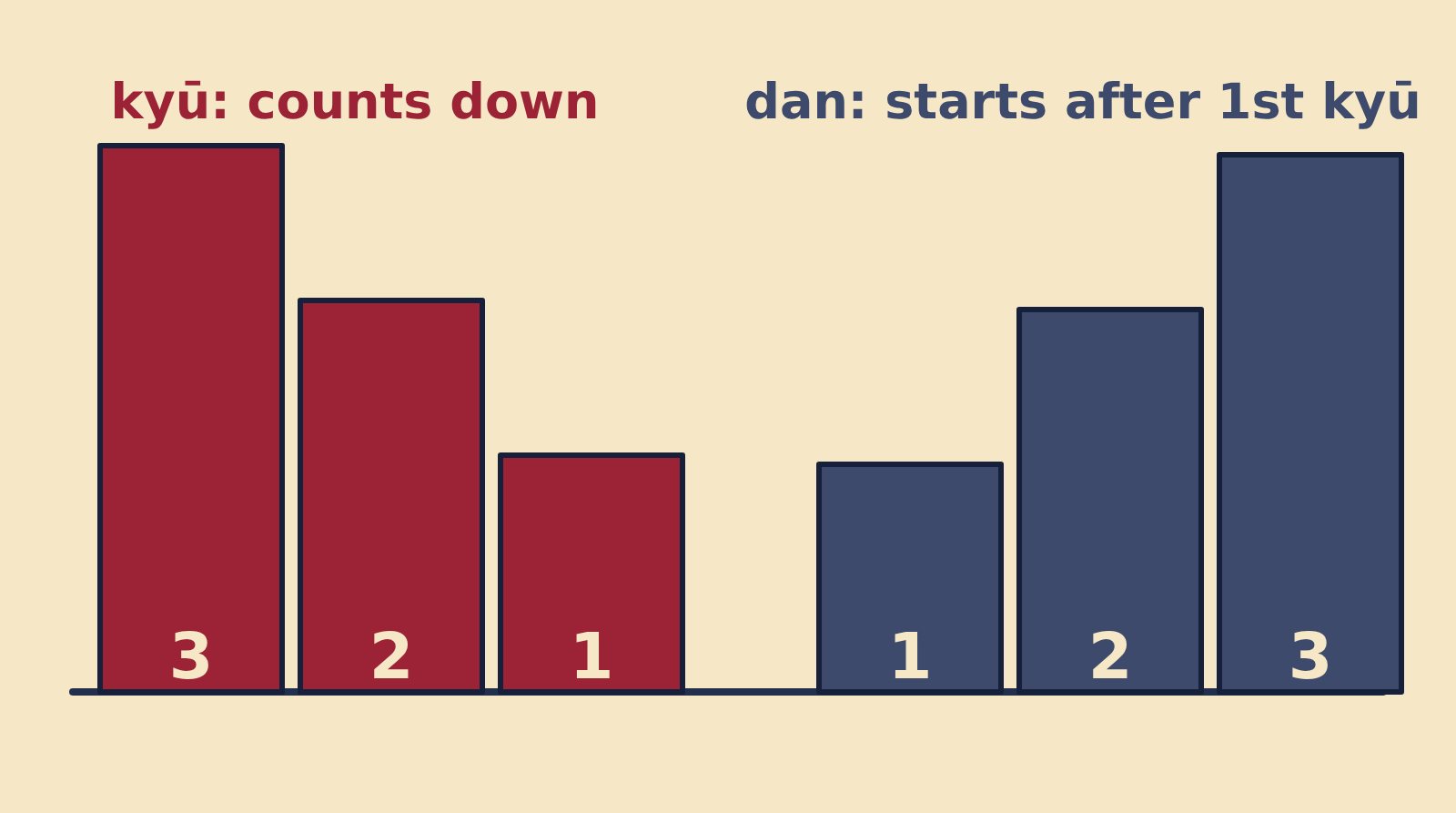
According to Wikipedia’s Kyū entry, kyū is “a Japanese term used in modern martial arts” for levels of skill. The detail that surprises most beginners is the direction: “Kyū ranks progress using a descending order system, so 1st kyū is the highest.” The entry explains the logic this way: the kyū is the number of steps before reaching mastery, whereas the dan gives steps into mastery.
The dan ranks begin after 1st kyū. Shodan, the first black belt degree, marks the move from kyū to dan. The entry notes that practitioners at kyū level are often called mudansha, “ones without rank”, and holders of any black belt degree are called yūdansha, “one with rank”.
One more caution from the same entry: “there is no standard association of belt colours with particular ranks.” So a belt colour that means one thing in one dojo cannot be assumed to mean the same in another. For your own dojo, the colours are something to ask about, not assume.
What the dojo publishes about grading
The dojo’s site is short on detail but clear on the basics:
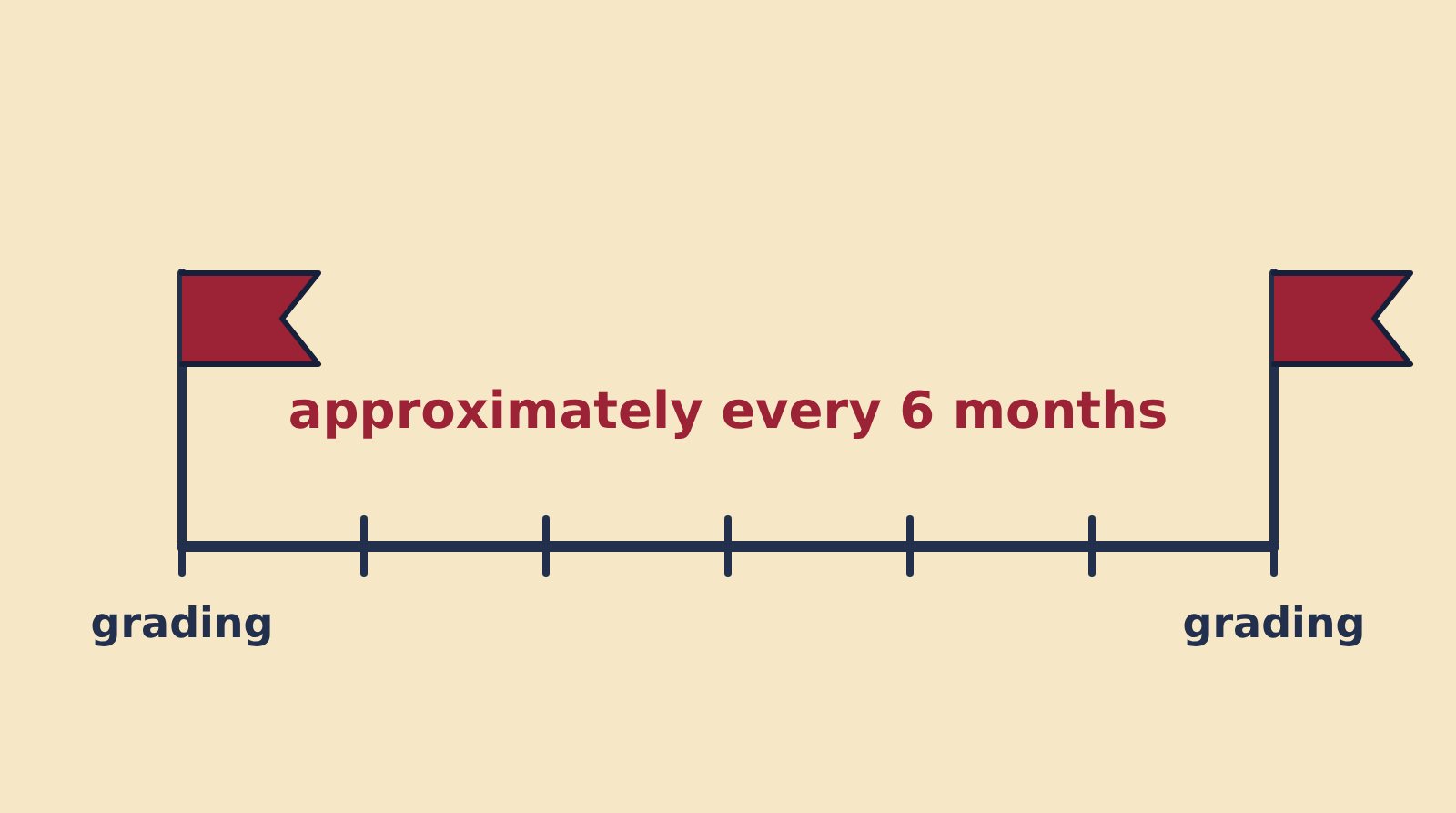
- How often: “grading is held approximately every 6 months”.
- What it costs: “Cost of grading separate.” No amount is given on the site.
- What you need: “Cost of gi, badge and belt not included”, meaning the uniform, badge and belt are bought on top of the one-off $20 joining fee. You do not need a uniform for your first two free classes.
- The path: the Teens & Adults program promises “a clear path to black belt”, and a Black Belt & Advanced program covers “deep study of Seibukan kata, bunkai and weapons for senior students”.
- The syllabus: the site lists the kata the dojo teaches (see below).
What the site does not say, so ask
Here is what we could not find on the site, and what we would ask an instructor on the intro call. These are our suggestions, not the dojo’s wording:
- How many kyū grades are there before black belt, and what colour is each?
- What does a grading involve, and what do students need to show?
- Which kata or skills are needed for each grade?
- What does a grading cost, and when is the next one?
- How many classes should a student expect to attend between gradings?
- Can a student attend a grading if they only train one day a week?
The answers are not hidden, they are just not written down on a one-page site. A good dojo will be glad you asked.
The kata the dojo teaches
The dojo lists these kata on its site: Fukyugata Ichi, Fukyugata Ni, Pinan 1 to 5, Naihanchi 1 to 3, Seisan, Ananku, Wansu, Passai, Gojushiho, Chinto, Kusanku, Wanchin, Jion, Passai Guwa and Tokumine no Kun. The site does not say which kata belongs to which grade, so we will not match them up. What a list like this does tell you is that there is a defined body of material to work through. A kata, as Wikipedia puts it, is “a detailed choreographed pattern of martial arts movements” practised to memorise and perfect them.
Twice a week or once?
The dojo is open about this. Its site says “Best results: train twice a week”, and that training one day a week “gives slower progress”. It does not say how much slower, or how that affects a grading date, so ask that too. The gradings themselves come around about every six months whichever plan you are on, as far as the site says.
The arithmetic is worth a moment. Six months is roughly 26 weeks, but not every week is a teaching week. The current term, for example, runs from 7 October to 18 December. If every Wednesday and Friday in that term has a class, a student on the two-day plan has up to 22 class nights in it. The site does not guarantee that, so confirm the term dates and any gaps.
One number from the instructors’ bios
On the site, Sensei Prinkal Nizama, Chief Instructor and Technical Director (Godan), is described as having 31 years of karate and as having taught 250 or more students in India, about 100 of them to black belt. It is a useful sign of experience taking students all the way through. We will not turn it into a pass rate or a time to black belt, because the site gives no timeframe and we would only be guessing.
What it costs
All prices are from the dojo’s site, in NZD, per person, per month, except where stated.

| What | Cost |
|---|---|
| First 2 classes | Free, with no obligation |
| Teens & Adults, 2 days a week (recommended) / 1 day a week | $95 / $65 per month |
| Juniors and Seniors, 2 days a week (recommended) / 1 day a week | $85 / $55 per month |
| Joining fee | $20, one-off, covers your passbook |
| Gi, badge and belt | Not included |
| Grading | Charged separately, about every 6 months. No amount is published. |
The passbook lets you train at any IOSSKA dojo worldwide. Every additional family member gets 50% off the monthly fee, on either plan.
How to try it
- Book. Call 029 128 0873 or fill in the booking form. An instructor will call within one working day. That call is the time to ask the grading questions above.
- Wear comfortable clothes you can move in. You do not need a uniform yet.
- Arrive 10 minutes early, on a Wednesday or Friday, 6 to 7pm.
For what the evening involves, see what to expect at your first class.
Frequently asked questions
How often does the Ōrākei dojo hold gradings?
The dojo’s site says grading is held approximately every 6 months.
How much does a karate grading cost?
The dojo says the cost of grading is separate, but it does not publish an amount. Ask an instructor when you book your free classes.
What does kyū mean in karate?
Kyū is a Japanese term for levels of skill below black belt. Kyū grades count down, so 1st kyū is the highest, and the dan ranks begin after it, according to Wikipedia.
How long does it take to get a black belt?
The dojo does not publish a timeframe. Its site promises a clear path to black belt, says gradings are about every six months, and recommends training twice a week for the best results. Ask the instructors what they expect for a beginner.
Do I need a uniform or belt to start?
No. Your first two classes are free and you wear comfortable clothes you can move in. The gi, badge and belt are bought separately if you continue.
Sources
- IOSSKA-NZ, seibukan.co.nz: grading frequency and cost wording, program descriptions, kata list, instructor bio and pricing (checked October 2026).
- Kyū, Wikipedia: how kyū and dan ranks work, and the note that belt colours are not standardised.
- Kata, Wikipedia: what a kata is.
Ready to try it? Your first two classes are free: Wednesdays and Fridays, 6 to 7pm, at Ōrākei Community Centre. Call now or fill in the form.